
A catalog can make throttle valve vs needle valve sound like a choice between two completely different products. In hydraulic work, that is often misleading. Throttle valve describes the job: creating an adjustable restriction. Needle valve describes one common way to build that restriction, using a tapered stem moving toward or away from a seat.
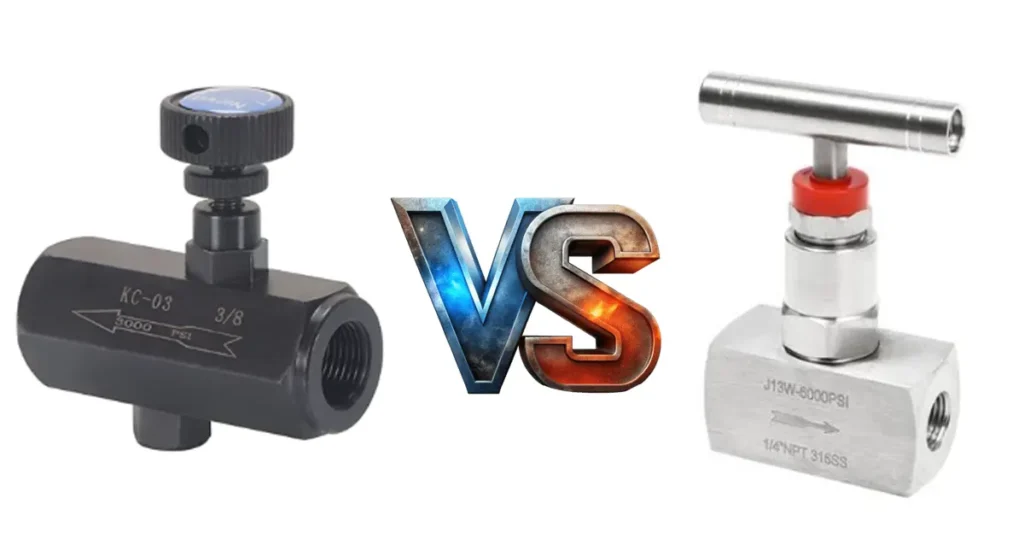
So a needle valve can be a throttle valve. Not every throttle valve uses a needle, and not every product sold as a needle valve has the same metering range, shutoff performance, reverse-flow path, or hydraulic pressure rating. Choose from the internal design and circuit requirement, not the label alone.
The short answer: one name is functional, the other is geometric
| Question | Throttle valve | Needle valve |
|---|---|---|
| What does the name describe? | The function of restricting flow | A tapered needle or stem geometry |
| Can it use a needle? | Yes, very commonly | Yes, by definition of the product family |
| Is it automatically pressure compensated? | No | No |
| Does it automatically provide free reverse flow? | No; a check path must be part of the design | No; a check path must be part of the design |
| Is it suitable for positive isolation? | Only if the exact design has a verified shutoff rating | Only if the exact design has a verified shutoff rating |
| What should you compare? | Metering curve, range, direction, delta p, pressure, fluid, lock, and connections | The same items, plus needle profile, stem pitch, and seat design |
This overlap is not just a naming debate. HYDAC describes one needle/poppet product as an an adjustable, non-pressure-compensated hydraulic flow restrictor. Bosch Rexroth describes a needle restrictor with adjustable flow in one direction and free flow through a check function in the other. Both are needle-based components performing a throttling function, yet their circuit behavior depends on the added features.
How a needle valve meters hydraulic flow
Turn the handwheel or adjustment screw and a finely threaded stem moves the tapered needle along its axis. As the needle moves away from the seat, the annular opening grows. Move it toward the seat and the opening becomes smaller.
The taper and thread pitch spread the change in opening over multiple turns. That can give you finer manual adjustment than a quarter-turn element, especially at low flow. But needle valve does not guarantee a particular accuracy. A blunt taper, coarse thread, backlash, vibration, worn seat, or oversized flow range can make adjustment difficult.
What else can a throttle valve use?
A throttle valve only needs a controllable restriction. The moving element can be a needle, a shaped spool, a slotted sleeve, a notched poppet, a rotary element, or another variable-orifice geometry. Fixed orifices also throttle flow, although they are not adjustable valves.
Some geometries are chosen for a wider flow range, compact cartridge packaging, lower operating effort, or a specific opening curve. Others are designed to give more useful resolution near the closed position. You cannot rank them without the pressure-drop and flow curve for the exact model.
A proportional throttle valve is another distinct case. An electrical or hydraulic command moves the metering element, but the component may still be non-pressure-compensated unless a compensator is added. The terms proportional, needle, and pressure compensated describe different parts of the design.
Both valves usually respond to pressure difference
For a simple variable restriction, the underlying relationship is:
Q = Cd x A x sqrt(2 x delta p / rho)
Q is flow, Cd is the discharge coefficient, A is effective opening, delta p is pressure difference across the opening, and rho is fluid density. At the same setting, a larger delta p generally produces more flow. If the load changes the pressure on the downstream side, actuator speed can change even though the handwheel does not move.
That applies to a basic needle valve and to another non-compensated throttle geometry. A pressure compensator is a separate mechanism that works to maintain a more constant differential across the metering opening. The comparison between a throttle valve and a pressure-compensated flow control valve becomes important when your load changes and speed must remain stable.
One-way and bidirectional behavior matters more than the name
Suppose you want to slow a cylinder in one direction and let it return with little restriction. The valve needs a controlled metering path in one direction and a bypass check in the other. A plain bidirectional needle valve restricts both directions because the same opening carries both flows.
Chenyang lists the STU as a unidirectional throttle valve and the STB as a bidirectional throttle valve. Use the port diagram and arrow for the exact model to confirm which direction is metered and how reverse flow behaves. Do not identify direction from the adjustment knob or body shape alone.
| Your circuit need | Design feature to request | What to verify |
|---|---|---|
| Meter one direction, freer return | Throttle or needle restriction with reverse-flow check | Metered direction, cracking pressure, reverse-flow delta p, and check leakage |
| Meter both directions | Bidirectional adjustable restriction | Flow curve in each direction and required adjustment range |
| Stable flow as load changes | Pressure-compensated flow control | Minimum regulating delta p, regulated range, accuracy conditions, and reverse path |
| Positive service isolation | Purpose-rated shut-off valve | Pressure direction, leakage limit, temperature, and operating procedure |
Do not confuse metering with shutoff
A needle can touch its seat and appear closed, but the product may be sold as a restrictor rather than an isolation valve. The catalog may allow some closed-position leakage, or the stem may not be designed for the torque used to create tight shutoff.
If your maintenance procedure depends on isolation, use a valve with a verified shutoff function and leakage criterion. Do not rely on the adjustment reaching zero on a scale. Conversely, a ball valve made for quick isolation is not a substitute for fine metering; its useful throttling range is usually limited and partial opening can damage seats.
Choose from the adjustment you actually need
A needle-style design is a good candidate when small manual changes matter, the required flow is within its useful range, and the oil is clean enough for a small metering gap. Typical examples include gauge damping, controlled pilot flow, test equipment, lubrication flow, and slow actuator adjustment. The exact product must still be rated for the circuit pressure, fluid, temperature, and required shutoff behavior.
Another throttle geometry may be better when the required flow range is larger, packaging is tighter, actuation is remote, or a particular flow-opening characteristic is needed. If normal flow sits close to the fully closed end of an oversized valve, even a fine needle can feel touchy. If it sits near full opening, you may not have enough reserve flow.
Ask the supplier for a flow-versus-adjustment curve when repeatability matters. A pressure-drop curve at fully open tells you capacity, but not how many usable turns exist around your normal setting.
Check heat before closing the valve further
Throttling does not remove hydraulic power; it converts pressure loss into heat. A useful estimate is:
Power loss (kW) = delta p (bar) x Q (L/min) / 600
At 25 L/min and a 20 bar drop, the valve turns about 0.83 kW into heat. If that happens continuously, the reservoir and cooler have to reject it. A smaller opening may achieve the target speed while creating an oil-temperature problem.
Also check what happens to excess pump flow. In a fixed-displacement circuit, restricting one branch can force more flow across a relief path. That loss may be larger than the heat at the throttle itself. Measure rather than guessing from handwheel position.
Meter-in or meter-out changes the risk
Meter-in restriction controls flow entering the actuator. It can work where the load resists motion. If gravity or an external force drives the actuator, the load may run ahead of supply flow, causing cavitation and unstable motion.
Meter-out restriction controls flow leaving the actuator and creates back pressure against an overrunning load. That can improve motion control, but cylinder area ratio can intensify pressure in the outlet chamber. Verify the maximum pressure at the cylinder, valve, hose, and fittings.
Neither arrangement turns a throttle or needle valve into a certified load-holding device. Where falling motion creates a personnel hazard, the complete load-control circuit needs a separate safety evaluation. The hydraulic throttle valve symbols help you see whether the drawing includes a plain restriction or a restriction with a reverse check.
Compare these specifications before you buy
- Required function: adjustable restriction, fine metering, free reverse flow, compensated flow, or true isolation
- Flow range: minimum controllable, normal, and maximum flow in each direction
- Pressure: working, peak, reverse, and port-specific limits
- Pressure drop: delta p at normal and maximum flow, fully open and at the expected setting
- Adjustment: needle profile, number of turns, scale, locknut, panel mounting, and vibration resistance
- Fluid: oil type, viscosity grade, additives, and contamination requirement
- Temperature: cold start and stabilized operating range for the complete valve
- Connections: NPT, BSP/G, metric, SAE, or manifold interface and sealing method
- Materials: body, needle or spool, seat, O-rings, backup rings, and surface treatment
- Installation: flow arrow, orientation, access for adjustment, and space to remove the valve
The hydraulic throttle valve page lists Chenyang’s STU and STB families and common connection and material options. Confirm final pressure, flow, dimensions, and direction from the selected model data rather than applying one series value to every valve.
Common comparison mistakes
Needle valves are precise, but throttle valves are not
A needle valve is often a throttle valve. Precision depends on taper, stem pitch, range, pressure conditions, viscosity, hysteresis, and wear. Ask for the curve and required repeatability.
If it closes, it is a shut-off valve
Physical closure does not establish an isolation rating or leakage limit. Check the manufacturer’s stated function and test conditions.
The same port size means the same flow
Internal passage, needle lift, seat diameter, check path, and turns in the body can produce very different pressure drops.
A locknut fixes unstable speed
A lock prevents the setting from moving. It cannot compensate for changing load pressure, oil viscosity, pump flow, or internal leakage.
One-way flow control works in either orientation
Reversing it swaps the metered and freer-flow directions. Check the symbol and arrow before connecting the hoses.
A quick decision for real equipment
| If your equipment needs… | Start with… | Then confirm… |
|---|---|---|
| Fine manual adjustment of a small hydraulic or instrument flow | A needle or fine-metering valve rated for the fluid and pressure | Usable turns around normal flow, leakage, and cleanliness |
| Basic cylinder speed adjustment with a steady resisting load | A correctly ranged throttle/needle valve | Heat, load variation, and meter-in or meter-out placement |
| Controlled motion one way and freer return | A one-way throttle or needle restrictor with check | Direction, cracking pressure, and reverse delta p |
| Restriction in both flow directions | A bidirectional throttle valve | Return-flow volume and pressure drop in each direction |
| Stable actuator speed under changing load | A pressure-compensated flow control | Minimum control differential and regulated flow range |
| Fast, visible line isolation | A purpose-rated ball or shut-off valve | Pressure direction, bore, torque, and leakage requirement |
Frequently asked questions
Is a throttle valve the same as a needle valve?
Sometimes. A needle valve performs a throttling function by changing the gap between a tapered stem and seat. But throttle valves can use other metering geometries, so the terms overlap without being identical.
Which gives finer flow adjustment?
A well-designed needle or fine-metering valve often provides useful multi-turn adjustment at low flow. The actual result depends on taper, thread pitch, flow range, delta p, viscosity, and wear. Compare curves for the exact models.
Can a needle valve keep cylinder speed constant?
Not by itself when load pressure changes. A basic needle valve is a non-compensated restriction, so flow changes with delta p and viscosity. Use pressure compensation when the process requires stable speed across variable loads.
Can I use a needle valve for hydraulic shutoff?
Only when the selected product has a verified shutoff function, pressure rating, and leakage limit for your conditions. Do not infer isolation performance from the needle touching the seat.
What is a throttle check valve?
It combines a throttle or needle restriction for controlled flow in one direction with a check-valve path for freer flow in the other. Port orientation determines which stroke is controlled.
Why does my setting change after the oil warms up?
Oil viscosity decreases as temperature rises, pressure loss changes, and internal leakage can increase. Repeat the test at controlled load, temperature, pressure, and pump speed before deciding the adjustment moved.
To choose between Chenyang’s unidirectional and bidirectional throttle options, provide the controlled direction, required reverse-flow behavior, minimum and maximum flow, working and peak pressure, oil and temperature, connection standard, and available installation space. Those details reveal whether you need a needle-style metering function, a check bypass, pressure compensation, or a different valve altogether.