When you see a restriction symbol with a diagonal arrow, you already know the circuit is trying to control flow through an adjustable opening. Add a check valve in parallel, and the same symbol may describe a valve that meters one direction while allowing freer return flow in the other.
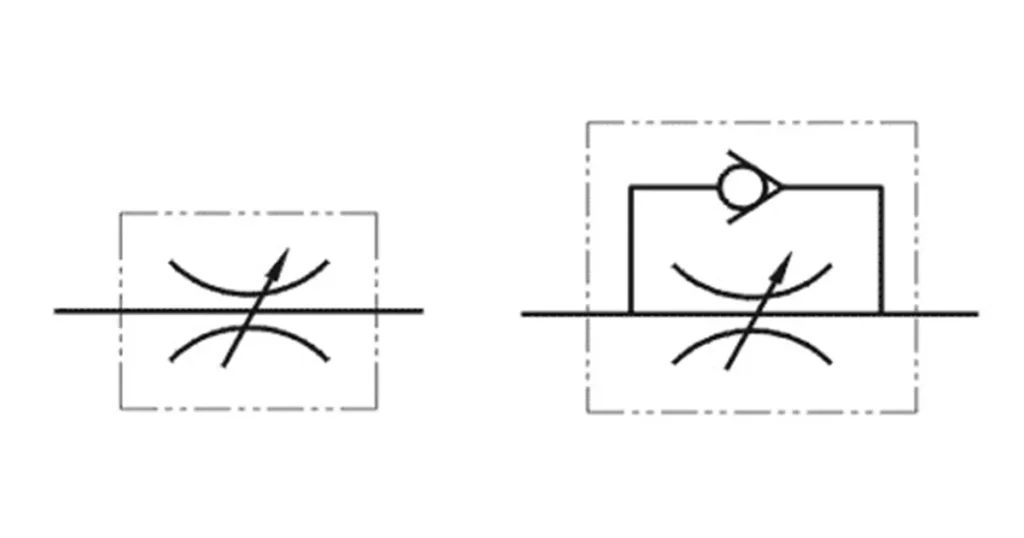
Do not order the valve from that symbol alone. It does not give you the port thread, pressure rating, usable flow range, adjustment sensitivity, or acceptable pressure drop. First read the function from the complete circuit; then match the hardware to your machine data.
The basic symbol: a restriction in the flow path
In an ISO 1219-style schematic, the restriction element sits directly in the oil path. Read it as a narrowed flow area. When oil passes through that opening, pressure falls across the element and some hydraulic power becomes heat. The drawing style may vary slightly, but that operating principle does not.
| Visual feature | Usual meaning | What you still need |
|---|---|---|
| Restriction element in the line | Flow is deliberately limited | Orifice size, rated flow and allowed pressure drop |
| Diagonal variability arrow crossing it | The opening is adjustable | Adjustment mechanism, lock and usable range |
| No variability arrow | The restriction is fixed | Calibrated opening and tolerance |
| Check-valve path in parallel | Restricted one way, freer the other | Metered direction, cracking pressure and reverse-flow Δp |
| Compensating element added | Pressure-compensated flow control | Compensation range, accuracy and minimum Δp |
Tip: The slanted arrow across a restriction means adjustable; it does not show flow direction. Trace the oil path and the orientation of the check element before you choose the valve direction.
Fixed versus adjustable throttle symbols
Fixed restriction
If there is no diagonal adjustment arrow, you are looking at a fixed restriction. The hardware may be a drilled orifice, calibrated insert, or restrictor fitting. You can use it to limit speed, damp a pilot signal, or soften a transient, but the resulting flow still changes with pressure differential and oil viscosity.
Do not assume a fixed opening means constant flow. If the actuator load increases the pressure differential across the orifice, flow changes. When the oil warms and viscosity falls, the same opening can behave differently again.
Adjustable throttle valve
The diagonal arrow adds adjustability. Inside the real valve, a needle, tapered stem, or another metering geometry changes the flow area as you turn the control. You are setting an opening, not commanding an exact flow independent of load.
On your machine, the useful range may occupy only part of the available turns. Near closed, a small adjustment can change cylinder speed sharply; near fully open, another turn may make little difference. If operators must repeat a setting, ask for flow-versus-position data at stated pressure and oil temperature, plus a locking method.
How to read a one-way throttle valve symbol
A one-way throttle has two parallel paths:
- a restricted path through the throttle; and
- a check-valve path that opens more freely in the opposite direction.
The parallel branch is the clue. Ignore the diagonal adjustment arrow when deciding direction and trace the check valve instead. Test both possible flow directions on the drawing before you choose the physical valve orientation.
- Choose a proposed flow direction through the external ports.
- Look at the check element in the parallel branch.
- If that direction pushes it away from the seat, the bypass opens.
- If that direction pushes it onto the seat, the bypass closes and flow must pass through the restriction.
- Repeat in the opposite direction to confirm the result.
| Example direction | Check path | Result |
| A → B | Closed | Oil passes through the adjustable restriction |
| B → A | Open | Oil takes the freer bypass path |
This is the functional logic, not a substitute for the actual ISO symbol. On an existing machine, confirm the flow arrow and port marking on the physical valve too.
Throttle valve or pressure-compensated flow control?
If your cylinder holds the correct speed without load but slows when the load rises, the valve may be behaving normally rather than failing. A basic throttle only sets an opening, so flow changes with pressure differential and viscosity. A pressure-compensated control adds a regulating element that keeps the differential across the metering opening more stable, reducing speed variation within its specified range.
| Question | Basic throttle | Pressure-compensated control |
| What is controlled directly? | Flow area | Metering area plus compensated pressure differential |
| Does load change affect flow? | Usually, significantly | Variation is reduced within the specified range |
| Does temperature matter? | Yes | Yes; compensation does not remove all viscosity effects |
| Is the symbol only a restriction? | Yes, fixed or adjustable | No; an additional compensation function is shown |
| Main selection question | Is simple speed trimming enough? | How stable must speed stay as load changes? |
If the drawing shows only an adjustable restriction but the machine needs load-independent speed, the problem may be the circuit concept rather than a failed valve.
Meter-in, meter-out and bleed-off placement
The same throttle symbol behaves differently depending on location.
Meter-in control
With meter-in control, you restrict oil entering the actuator. This can work well when the load resists motion. If the load tries to pull the actuator faster than the pump supplies oil, however, meter-in control may allow run-away movement or cavitation. That is a circuit risk, not something you can solve by simply closing the throttle further.
Meter-out control
With meter-out control, you restrict oil leaving the actuator. The resulting back pressure can help control an overrunning load, but it may also intensify pressure on the opposite cylinder chamber because the piston and annulus areas differ. Check the maximum possible port pressure before you approve the valve, hose, and fittings.
Bleed-off control
The throttle diverts part of pump flow away from the actuator. This can reduce throttling loss in some arrangements, but speed remains sensitive to load and supply behavior. Symbol position in the complete circuit tells you which arrangement is used.
Note: A throttle valve is not automatically a safe load-holding device. If a falling load can injure someone or damage equipment, use a circuit designed and validated for load control.
Do not mix hydraulic symbols with P&ID symbols
Search results often mix fluid-power schematics with process piping and instrumentation diagrams. They serve different purposes.
- Hydraulic fluid-power symbols describe function and connection logic. ISO 1219-1 is the primary international reference.
- P&ID symbols show process equipment, piping, valve bodies, actuators and instrumentation. They may use different standards or company legends.
A globe-valve-looking icon on a process drawing is not the symbol you should use to identify an adjustable hydraulic restriction. Check the drawing legend and document standard.
Common symbol-reading mistakes
Using the adjustment arrow as flow direction
The variability arrow shows that a setting changes. Flow direction comes from the path and, for a one-way valve, check orientation.
Assuming every throttle is one-way
A simple adjustable restriction meters both directions. You need the parallel check symbol for a restricted/free-flow combination.
Calling a throttle a constant-flow valve
Without pressure compensation, the same setting can produce different flow under a different load or oil temperature.
Ignoring the complete circuit
The symbol alone does not tell you whether the restriction controls inlet, outlet or bypass flow. Trace the pump, actuator, return and alternate paths.
Choosing hardware from the symbol alone
The schematic tells you the function, but your purchase specification must finish the job. Add working and peak pressure, flow range, allowed Δp, fluid, temperature, port type, materials, seal compatibility, adjustment method, and mounting limits.
From symbol to valve specification
| Schematic function | RFQ information to add |
|---|---|
| Adjustable bidirectional throttle | Metered flow range, Δp, setting reference and lock requirement |
| One-way throttle with check bypass | Metered/free direction, cracking pressure and reverse-flow Δp |
| Pressure-compensated flow control | Flow range, compensation range, accuracy and minimum Δp |
| Any throttle function | Working/peak pressure, fluid, temperature, ports, materials and seals |
If your circuit needs an adjustable restriction, compare it with Chenyang hydraulic throttle valves, including one-way STU/STB configurations, or the broader hydraulic flow-control valve range. Match the symbol function and free-flow direction first, then verify the exact operating data for your pressure and flow.
The article on types of throttle valves explains how physical configurations differ.
FAQ
What is the hydraulic throttle valve symbol?
It is a fluid-power symbol for a restriction that limits flow. A diagonal variability arrow indicates adjustability; no arrow indicates a fixed restriction.
What does a check valve next to the throttle mean?
When drawn in parallel, it usually means metered flow in one direction and freer flow through the check in the other.
Does the arrow across a throttle show flow direction?
No. It shows adjustability. Trace the circuit and check-valve orientation for flow direction.
Is a needle valve symbol the same as a throttle valve symbol?
An adjustable restriction represents the metering function commonly produced by a needle-type valve. The symbol gives function, not internal geometry, so confirm construction separately.
Can a throttle keep cylinder speed constant?
Only within circuit limits. A simple throttle is affected by load and viscosity. A pressure-compensated control is better when speed must stay steadier.
Which standard defines hydraulic valve symbols?
ISO 1219-1 defines graphical symbols and related conventions for fluid-power systems. Use the edition required by your drawing or customer.