
If you work with hydraulic systems, you have probably heard about throttle valves and flow control valves. Many people think these two valves do the same thing. But they are different. If you use the wrong one, your system might not work right. You could get speed changes, poor performance, or even damage to your equipment. Look at the table below to see what can go wrong when you pick the wrong valve:
| Problem | What Happens |
| Actuator Speed Changes | If you use a throttle valve in a high-load system, the speed of your cylinder or motor changes with the load. Your machine does not move at a steady rate. |
| Poor Precision | Without pressure compensation, flow changes every time the load shifts. This makes it hard to control your system precisely. |
| Energy Waste | The wrong valve can make your pump work harder than needed. This uses more energy and raises your running costs. |
| Equipment Wear | Unsteady flow causes vibration and shock. Over time, this wears out seals, hoses, and other parts faster. |
| System Downtime | If the valve fails or leaks, your machine stops working. You lose production time and spend money on repairs. |
Picking the right valve saves you money and keeps your system running well. This guide explains the differences between throttle valves and flow control valves. It helps you choose the best one for your job.
Key Takeaways
- A throttle valve controls flow by changing the size of the opening. It does not adjust for pressure changes.
- A flow control valve keeps the flow rate steady even when the load or pressure changes.
- Throttle valves are simple and low cost. They work well for basic speed control jobs.
- Pressure-compensated flow control valves are best when you need constant actuator speed under changing loads.
- Meter-in controls the flow going into an actuator. Meter-out controls the flow leaving an actuator.
- Always match your valve type to your system pressure, load type, and speed precision needs.
- Using the wrong valve can cause speed changes, energy waste, and equipment damage.
- For custom hydraulic throttle valves, Chenyang Hydraulic offers solutions for many applications.
What Is a Hydraulic Throttle Valve?
A hydraulic throttle valve is a simple device. It controls flow by changing the size of the opening inside the valve. When you make the opening smaller, less fluid passes through. When you make it larger, more fluid passes through. This changes the speed of your actuator, like a cylinder or a hydraulic motor.
The throttle valve does not care about pressure. If the load on your system changes, the pressure changes too. When pressure changes, the flow through a throttle valve also changes. This means your actuator speed can go up or down depending on the load. For simple jobs where you do not need precise speed control, a throttle valve works well.
How a Throttle Valve Works
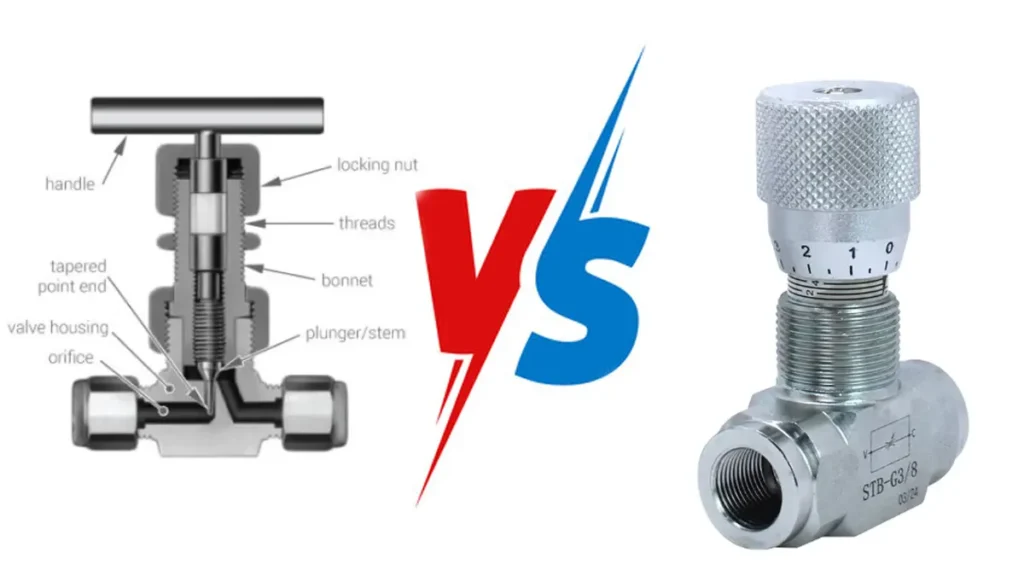
Inside a throttle valve, there is a small passageway. You can adjust how big or small this passageway is. The most common type is a needle valve. The needle moves in or out to change the opening size. When the opening is small, fluid slows down. When it is large, fluid moves faster.
The throttle valve creates a pressure drop across the opening. This pressure drop is what slows the flow. But here is the key point: the flow rate depends on both the opening size AND the pressure difference. If the pressure changes, the flow changes too. This is the main limitation of a throttle valve.
Tip: A throttle valve is also called a needle valve or a flow restrictor in some catalogs. They all work on the same principle: restrict the orifice to reduce flow.
Common Types of Throttle Valves
Throttle valves come in several designs. Here is a table to show the main types:
| Type | How It Works | Best For |
| Needle Valve | A tapered needle moves in or out to change orifice size | Fine flow adjustment, low to medium pressure |
| Globe Valve (Throttling) | A disc moves up and down over a seat to restrict flow | Medium pressure, throttling in pipelines |
| Ball Valve (Partial Open) | A ball rotates to partially block flow | Simple on/off with some throttling, not precise |
| Gate Valve (Throttling) | A gate partially blocks the flow path | Low precision throttling in larger pipes |
Where Throttle Valves Are Used
- Simple cylinder speed control where exact speed is not critical
- Agricultural machinery and basic construction equipment
- Low-cost hydraulic systems with steady loads
- Cooling and lubrication circuits where flow variation is acceptable
- Test benches and simple industrial machines
What Is a Hydraulic Flow Control Valve?
A hydraulic flow control valve does more than just restrict flow. It keeps the flow rate steady even when the pressure in your system changes. This is the key difference from a throttle valve. A flow control valve uses a pressure-compensating mechanism to maintain a constant flow. Your actuator moves at the same speed no matter how the load changes.
Flow control valves are more complex than throttle valves. They have extra parts inside that sense pressure changes and adjust automatically. This makes them more expensive but much more accurate. If you need your machine to move at a consistent speed, a flow control valve is the right choice.
How a Flow Control Valve Works
A pressure-compensated flow control valve has two main parts: a variable orifice and a pressure compensator. The variable orifice sets the flow rate you want. The pressure compensator senses the pressure drop across the orifice and adjusts itself to keep it constant. Because the pressure drop stays the same, the flow rate stays the same too.
Here is a simple way to understand it: Imagine you are pouring water through a hose. If someone pushes on the hose from outside (like a load on your actuator), a throttle valve would let less water through. But a flow control valve would automatically open a little more to keep the same flow. This is the power of pressure compensation.
Note: Not all flow control valves are pressure-compensated. A non-compensated flow control valve behaves like a throttle valve. Always check the product specs before you buy.
Common Types of Flow Control Valves
| Type | Compensation | Accuracy | Cost |
| Non-Compensated Flow Control | None | Low | Low |
| Pressure-Compensated Flow Control | Pressure only | High | Medium |
| Pressure & Temperature Compensated | Pressure and temperature | Very High | High |
| Priority Flow Control Valve | Diverts fixed flow to priority circuit | High | Medium-High |
Where Flow Control Valves Are Used
- Injection molding machines that need consistent platen speed
- Hydraulic presses where force and speed must be controlled precisely
- Construction equipment like excavator booms and arms
- Industrial robots and automation systems
- Marine and offshore hydraulic systems with varying loads
Throttle Valve vs Flow Control Valve: Key Differences
Now let’s compare these two valves side by side. This is the most important part of this guide. Understanding the differences helps you make the right choice for your system.
Structure and Working Principle
| Feature | Throttle Valve | Flow Control Valve |
| Main Function | Restrict orifice to reduce flow | Maintain constant flow rate |
| Pressure Compensation | No | Yes (in pressure-compensated types) |
| Internal Components | Orifice or needle only | Orifice + pressure compensator |
| Flow Accuracy | Low to medium | High |
| Sensitivity to Load Changes | High (flow changes with load) | Low (flow stays constant) |
| Structure Complexity | Simple | Complex |
| Adjustment Method | Manual or fixed orifice | Manual orifice + auto compensator |
Performance and Application Comparison
| Feature | Throttle Valve | Flow Control Valve |
| Cost | Lower | Higher |
| Maintenance | Easy, fewer parts | Moderate, more parts to service |
| Speed Stability | Poor under variable loads | Excellent under variable loads |
| Pressure Range | Wide | Wide (within compensator range) |
| Temperature Sensitivity | Moderate | Low (with temperature compensation) |
| Best Application | Simple, low-load systems | Precision, variable-load systems |
| Energy Efficiency | Moderate | Better (reduces wasted flow) |
| Size | Compact | Larger due to compensator |
When Load Changes Affect Flow (Throttle Valve Limitation)
Here is what happens in a real system when you use a throttle valve with a changing load. Imagine a hydraulic cylinder lifting a heavy load. When the load increases, the back pressure increases. This reduces the pressure difference across the throttle valve. Less pressure difference means less flow. Less flow means the cylinder slows down. You can see this as an unwanted speed change on your machine.
For many applications, this speed change is not acceptable. If you are cutting metal, welding, or doing precision assembly, you need steady speed. A throttle valve cannot give you this. You need a flow control valve.
Important: If your system has a variable load, always use a pressure-compensated flow control valve. A throttle valve will give you unstable actuator speed and poor performance.
When You Need Stable Flow (Flow Control Valve Advantage)
A pressure-compensated flow control valve shines in systems where the load changes during the work cycle. For example, an injection molding machine injects plastic at high pressure at the start, then the pressure drops as the mold fills. Without pressure compensation, the injection speed would change during the cycle. This causes quality problems like sink marks and weld lines. A flow control valve keeps the injection speed constant, giving you better part quality.
Meter-In vs Meter-Out: How Installation Affects Performance
When you install a throttle valve or flow control valve, you can put it in two different positions in the circuit. Each position gives different results. You need to know the difference to get the best performance.
| Installation | Description | Best For | Caution |
| Meter-In | Valve controls flow going INTO the actuator | Extending a cylinder against a resistive load | Not ideal for overrunning loads; cylinder may cavitate |
| Meter-Out | Valve controls flow leaving the actuator | Lowering loads, vertical cylinders, overrunning loads | Slightly lower efficiency due to back pressure |
| Bleed-Off | Valve diverts excess flow back to tank | Energy saving in simple circuits | Poor speed control accuracy |
Tip: Use meter-out for vertical cylinders holding a load. If you use meter-in on a vertical cylinder with a hanging load, the load can pull the cylinder down faster than the pump can fill it. This causes cavitation and jerky movement.
How to Choose Between a Throttle Valve and a Flow Control Valve
Now you understand how each valve works. Let’s talk about how to pick the right one for your system. You need to think about several things before you decide.
Check Your System Requirements
The first step is to look at what your system needs. Ask yourself these questions:
- Does my load change during the work cycle?
- How precise does the actuator speed need to be?
- What is the operating pressure range of my system?
- What is the temperature range of the hydraulic fluid?
- How often does this part need maintenance?
If your load changes a lot and you need steady speed, choose a flow control valve. If your load is steady and speed precision is not critical, a throttle valve is enough.
Consider Your Budget and Maintenance Plan
Cost is always a factor. Throttle valves cost less than flow control valves. They also have fewer parts, so maintenance is easier. But if a throttle valve causes your system to perform poorly, the cost of fixing quality problems or downtime can be much higher than the savings from buying a cheaper valve.
Think about the total cost of ownership. A more expensive flow control valve that keeps your machine running smoothly and producing good parts will save you money in the long run.
Quick Selection Guide
| Your Condition | Recommended Valve | Reason |
| Simple circuit, steady load, low cost priority | Throttle Valve (Needle Valve) | Sufficient for basic flow restriction |
| Variable load, need constant actuator speed | Pressure-Compensated Flow Control Valve | Maintains flow regardless of load changes |
| High temperature variation in system | Temperature & Pressure Compensated Flow Control Valve | Corrects for viscosity changes with temperature |
| Priority circuit (like steering) needs fixed flow | Priority Flow Control Valve | Guarantees flow to the priority circuit first |
| Vertical cylinder with hanging load | Flow Control Valve (Meter-Out) | Prevents cavitation and jerky movement |
| Low pressure, general purpose circuit | Throttle Valve | Simple, reliable, easy to maintain |
Common Mistakes When Selecting Hydraulic Flow Control Components
Using a Throttle Valve in a Variable-Load System
This is the most common mistake. Engineers pick a throttle valve because it is cheaper. But when the load changes during the work cycle, the actuator speed changes too. The machine does not perform correctly. Parts are made out of spec. Operators have to constantly readjust the valve. In the end, the system costs more to run than if you had used the right flow control valve from the start.
Note: If you see an operator constantly adjusting a throttle valve on your machine, that is a sign the system needs a pressure-compensated flow control valve instead.
Ignoring Pressure Compensation
Some buyers see the word “flow control valve” on a product and assume it is pressure-compensated. It may not be. A non-compensated flow control valve behaves just like a throttle valve. Always check the product datasheet. Look for the words “pressure-compensated” or “pressure compensator” in the specification. If you do not see these words, the valve does not compensate for pressure changes.
Installing the Valve in the Wrong Position
You learned about meter-in and meter-out earlier. Many technicians put the valve in the wrong position because they do not understand the difference. Putting a meter-in valve on a vertical cylinder with a hanging load causes cavitation and erratic movement. Always think about the load type before you decide where to put the valve.
Overlooking Temperature Effects on Flow
Hydraulic oil changes viscosity with temperature. Cold oil is thicker and flows more slowly. Hot oil is thinner and flows faster. If your system runs in a wide temperature range, a standard throttle valve or non-temperature-compensated flow control valve will give you different speeds at different temperatures. For systems that need very precise speed control across a wide temperature range, use a temperature and pressure compensated flow control valve.
Tip: Always check the expected operating temperature range of your system before selecting a flow control valve. If the range is wide (more than 30°C), consider a temperature-compensated valve.
Focusing Only on Size
Just like with ball valves, some buyers only match the port size. They think a 3/8″ flow control valve works the same as another 3/8″ valve. But the flow range, pressure rating, compensator type, and adjustment method all matter. Always check the full specification, not just the port size. Here is what you should confirm before buying:
| What to Check | Why It Matters |
| Port size and thread type | Ensures it fits your existing circuit |
| Maximum flow rate | Must match your actuator speed requirement |
| Operating pressure range | Must handle your system pressure |
| Pressure compensation | Required for variable-load systems |
| Temperature rating | Must cover your expected fluid temperature range |
| Adjustment type | Manual, remote, or fixed orifice |
| Material compatibility | Must work with your hydraulic fluid type |
Chenyang Hydraulic Throttle Valve Support
You might need something specific for your hydraulic system. Chenyang Hydraulic offers a range of throttle valves designed for high-pressure hydraulic applications. Whether you need a simple needle-style throttle valve or a custom solution for a special system, Chenyang Hydraulic can help.
| Capability | Details |
| Valve Types | Hydraulic throttle valves, needle valves, throttle check valves |
| Connection Types | NPT, BSP, Metric, SAE, Flanged |
| Operating Pressure | Up to 5000 PSI (350 bar) and above for custom designs |
| Materials | Carbon steel, stainless steel for corrosive environments |
| Customization | Custom port sizes, flow ranges, materials, and mounting styles |
| Design Support | Work from drawings, samples, or application specifications |
| Quality Control | Pressure tested and inspected before shipment |
If you need a throttle valve for a specific application, or if you are not sure whether a throttle valve or flow control valve is right for your system, contact Chenyang Hydraulic. Their engineering team can help you select or design the right valve for your job.
Conclusion
You now understand the key differences between a hydraulic throttle valve and a flow control valve. A throttle valve is simple and low cost. It restricts flow by changing the orifice size, but it does not compensate for pressure changes. A flow control valve is more complex. It keeps the flow rate constant even when the load or pressure in your system changes.
When you choose the right valve for your system, you get better performance, lower energy costs, and less wear on your equipment. For simple systems with steady loads, a throttle valve is a good choice. For precision systems with variable loads, you need a pressure-compensated flow control valve.
As a hydraulic valve manufacturer, Chenyang Hydraulic can help you choose the right valve based on your pressure rating, flow requirements, material needs, and working conditions. We also support custom hydraulic throttle valves based on drawings, samples, or special project needs.
If you need help selecting or customizing hydraulic throttle valves or flow control valves, contact Chenyang Hydraulic for professional support.
FAQ
What is the main difference between a throttle valve and a flow control valve?
A throttle valve restricts flow by reducing the orifice size, but the flow changes if the pressure changes. A flow control valve keeps the flow rate constant even when the pressure in the system changes. This is because a flow control valve has a pressure compensator inside that adjusts automatically.
Can I use a throttle valve instead of a flow control valve?
You can use a throttle valve in a simple system where the load does not change much and you do not need precise speed control. But if your load changes during the work cycle, a throttle valve will give you unstable actuator speed. In that case, you need a pressure-compensated flow control valve.
What is a pressure-compensated flow control valve?
A pressure-compensated flow control valve has two main parts: a variable orifice and a pressure compensator. The pressure compensator senses the pressure drop across the orifice and keeps it constant. This means the flow rate stays the same even when the system pressure changes due to load variation.
Which valve is better for hydraulic cylinder speed control?
For simple cylinders with steady loads, a throttle valve (needle valve) is enough. For cylinders that carry changing loads and need consistent speed, a pressure-compensated flow control valve is better. Also, consider meter-out installation for vertical cylinders with hanging loads to prevent cavitation.
What is meter-in and meter-out in hydraulic systems?
Meter-in means the flow control valve is placed on the supply side of the actuator. It controls how much fluid enters the actuator. Meter-out means the valve is placed on the return side. It controls how much fluid leaves the actuator. Meter-out is better for vertical cylinders or systems with overrunning loads because it prevents cavitation.
How do I adjust a hydraulic throttle valve?
Most hydraulic throttle valves have a manual adjustment knob or screw. Turning the knob clockwise usually reduces the orifice size and reduces flow. Turning it counterclockwise increases the orifice and increases flow. Some valves have a lock nut to hold the setting in place. Always adjust the valve slowly and watch the actuator speed to find the right setting.
Does temperature affect flow control valve performance?
Yes, temperature affects hydraulic oil viscosity. Cold oil is thicker and flows more slowly. Hot oil is thinner and flows faster. A standard throttle valve or non-temperature-compensated flow control valve will give different speeds at different temperatures. If your system operates across a wide temperature range, use a temperature and pressure compensated flow control valve for best results.
Where can I buy custom hydraulic throttle valves?
Chenyang Hydraulic offers custom hydraulic throttle valves for many applications. You can provide a drawing, a sample, or your application specifications. They will make a valve that fits your exact needs, including the right port size, connection type, pressure rating, and material.
What causes a hydraulic actuator to move at inconsistent speed?
The most common cause is using a throttle valve in a variable-load system. When the load changes, the pressure drop across the throttle valve changes, and the flow changes too. This makes the actuator speed up or slow down. To fix this, replace the throttle valve with a pressure-compensated flow control valve.
Is a needle valve the same as a throttle valve?
A needle valve is a type of throttle valve. It uses a tapered needle to adjust the orifice size. Needle valves give very fine flow adjustment and are popular in hydraulic systems for speed control. Not all throttle valves are needle valves, but all needle valves work on the throttle principle: restrict the opening to reduce flow.