You usually start looking inside a hydraulic valve because something has changed: the machine is losing pressure, a cylinder is drifting, or the handle suddenly feels too heavy. The fault may look like a bad valve, but the cause often sits at one component—a damaged seat, a contaminated moving element, a worn seal, a weak spring, or a distorted body.
If you know what each part does, you can work backward from the symptom instead of replacing parts at random. Start with the valve type. A ball valve, check valve, throttle valve, and spool valve control oil in different ways, so they do not share the same internal parts or failure patterns.
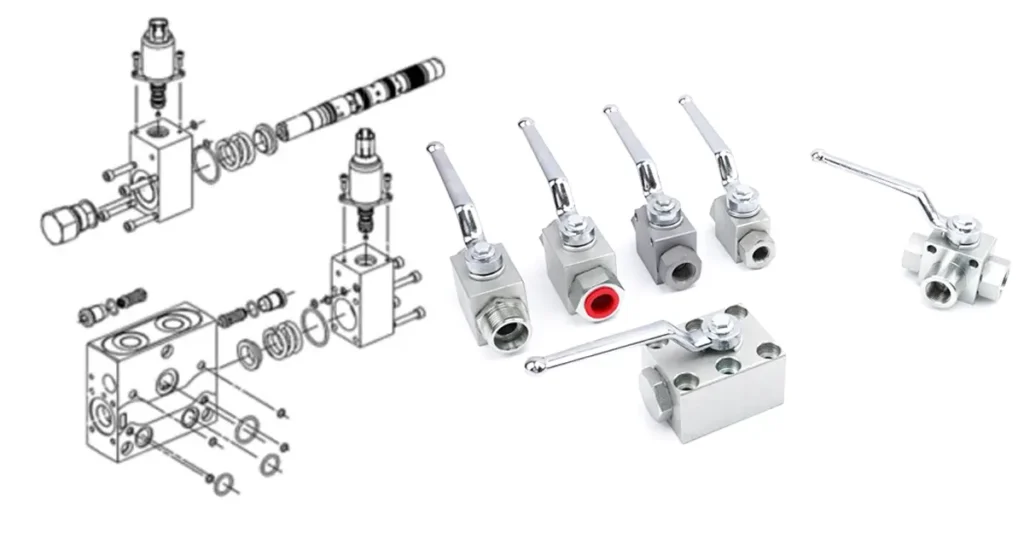
The component groups found in most hydraulic valves
| Component group | Main job | Typical failure effect |
|---|---|---|
| Body or housing | Contains pressure and locates internal passages and parts | External leakage, distortion, cracked threads, misalignment |
| Closure or metering element | Opens, blocks, redirects, or restricts flow | Internal leakage, sticking, incorrect flow, high torque |
| Seat or land | Creates the sealing or metering interface | Reverse leakage, failure to shut off, unstable regulation |
| Stem, plunger, or actuator interface | Transfers operating force to the internal element | Lost motion, binding, external leakage, incomplete travel |
| Spring | Sets bias, cracking pressure, return position, or control force | Wrong opening point, chatter, failure to return |
| Static and dynamic seals | Prevent leakage between parts or to the environment | External leakage, cross-port leakage, contamination entry |
| Ports and flow passages | Connect the valve to the hydraulic circuit | Pressure loss, cavitation, blocked flow, fitting leakage |
| Operator or actuator | Provides manual, mechanical, pneumatic, hydraulic, or electrical movement | No shift, partial shift, delayed response |
| Plugs, retainers, and fasteners | Close machining passages and hold the assembly together | Loosening, leakage, distortion, lost adjustment |
Valve body and internal passages
Think of the body as both the pressure boundary and the alignment fixture for everything inside the valve. If the body distorts, cracks at a port, or holds a bore out of line, a new seal will not solve the real problem. Carbon steel, stainless steel, cast iron, and aluminum can all be suitable, but the material name alone never proves the pressure rating. You still need the wall thickness, geometry, manufacturing route, heat treatment, thread design, and test conditions.
When a valve has an unexpected pressure drop, do not look only at the nominal port size. Follow the complete internal path. A narrow cross passage, sharp intersection, burr, or trapped chip can restrict flow, damage a seal, or jam a moving element even when the outside connection looks correct.
Chenyang’s current hydraulic ball valve range includes carbon-steel and stainless-steel options on verified models. Confirm the body material and surface treatment for the exact series instead of applying one model’s data to all products.
Ball, spool, poppet, and needle: four different moving elements
| Element | How it controls flow | Strength | Typical sensitivity |
|---|---|---|---|
| Ball | Rotates a bore into or out of alignment with the ports | Fast isolation and a direct flow path when open | Seat damage, trapped pressure, contamination at the sealing interface |
| Spool | Slides lands across ports and metering edges | Several flow paths and controlled metering in one element | Clearance, contamination, bore distortion, internal leakage |
| Poppet | Moves away from a seat | Compact seat-type closure and directional control | Seat damage, particles, spring force, pressure unbalance |
| Needle | Moves a tapered tip relative to an orifice | Fine manual adjustment of a restricted area | Small-passage contamination, erosion, setting drift |
Chenyang does not currently publish a general spool-valve product family. Spools are included here because the keyword covers hydraulic valves broadly and because technicians often need to distinguish spool leakage from seat leakage.
Ball valve components
If a ball valve leaks, feels stiff, or will not reach full open or closed position, trace the load path from the handle to the ball. The usual parts are the body, ball, seats, stem, stem seals, body seals, stops, retainers, and the handle or actuator interface. Two-piece and multi-piece valves arrange those joints differently, so a seal kit must match the exact construction.
The ball controls the main path. Its bore size influences flow area, but the complete valve’s pressure loss also depends on the ports, body transitions, and seat geometry. The seats support and seal against the ball. PTFE or POM may be used as seat materials on verified Chenyang models, while O-rings such as NBR or FKM may seal body joints or stems. Do not describe an O-ring automatically as the ball seat; these parts perform different jobs.
The stem has to transmit torque and seal a rotating pressure boundary at the same time. If the handle becomes hard to move, do not assume the handle is the problem. Pressure load, excessive seat preload, contamination, corrosion, body misalignment, or an undersized actuator can all raise the required torque.
Check valve components
When oil is flowing backward or a cylinder will not hold as expected, start with the check valve’s closing parts. A basic design uses a body, inlet and outlet passages, a ball or poppet, a seat, and often a spring. Guides, retainers, O-rings, and backup rings may also control alignment and sealing.
In the forward direction, inlet pressure pushes on the ball or poppet. The valve starts to open only after that force overcomes the spring preload, friction, and pressure on the opposite side. That is why changing the spring alone does not give you a predictable cracking pressure; the effective area and internal geometry matter too.
In reverse, pressure should push the element back onto its seat. If the valve still leaks backward, look for a particle on the seat, a damaged sealing line, a bent guide, or a broken spring before you blame the whole valve. The Chenyang inline check valve should be selected by its own documented pressure, flow, connection, and cracking behavior, not by the generic description of check-valve parts.
Throttle and flow-control components
If turning the adjustment changes speed in one direction but not the other, you may be looking at a one-way throttle rather than a simple bidirectional restriction. The core parts are a body, adjustable needle or spool, seat or orifice, adjustment screw or knob, stem seal, and locking parts. A one-way design adds a check element and spring in a parallel path.
The metering geometry determines how much the flow area changes for each turn or stroke. A long, gradual needle taper can give finer adjustment than an abrupt opening, but the useful range still depends on flow, pressure differential, viscosity, and the application.
A one-way product such as the STU throttle valve adds a reverse-flow check path. A bidirectional throttle omits that bypass or arranges the internals so both directions use the controlled restriction. Chenyang’s hydraulic throttle valve page is the commercial starting point for these models.
A pressure-compensated valve adds another control stage: a compensator spool or poppet, a bias spring, and pressure-sensing passages. Those parts try to hold a controlled pressure difference across the metering orifice. In your machine, a blocked sensing passage can look like a bad adjustment because the actuator speed starts changing with load even though the setting has not moved.
Seats and sealing interfaces
First decide where the oil is going. If it escapes outside the valve, check body joints, stems, plugs, covers, and fittings. If oil passes internally when the valve should be closed, look at the seat, land, or controlled clearance. An external O-ring and an internal valve seat solve different leakage paths.
| Sealing element | Typical role | Selection variables |
|---|---|---|
| Soft seat | Conforms against a ball or poppet | Fluid compatibility, temperature, pressure, extrusion, wear |
| Metal seat | Supports demanding temperature, wear, or pressure conditions when designed for it | Material pair, hardness, finish, contact geometry, leakage target |
| O-ring | Static or limited dynamic sealing in a groove | Compound, squeeze, groove, pressure, temperature, fluid |
| Backup ring | Supports an elastomer against extrusion | Clearance, pressure direction, material, temperature |
| Gasket or bonded seal | Seals a face, plug, or connection | Surface condition, preload, reuse policy, compatibility |
| Spool-to-bore clearance | Controls sliding fit and internal leakage without a contact seal | Diameter, geometry, viscosity, temperature, contamination |
NBR and FKM are elastomer families commonly used for O-rings, while PTFE, POM, and PEEK may be used in seats, backup rings, bearings, or other engineered parts depending on the design. Material roles are not interchangeable. Confirm the exact part location and compound, not just the material acronym.
Springs set more than return force
Springs can establish a check valve’s cracking force, return a spool, bias a compensator, maintain seat contact, or oppose pilot pressure. Their load depends on wire and coil geometry, material, free length, installed length, and travel.
Note: A similar-looking spring can still change cracking pressure or return behavior. Do not stretch, cut, shim, or substitute it unless the service procedure gives you an approved value and a way to retest the valve.
Operators, stems, pilots, and actuators
Choose the operator around the way the machine is used. A manual handle gives you direct position feedback but needs safe access. Pneumatic or hydraulic actuation gives you remote movement, but the actuator must still deliver enough torque or shifting force at the worst pressure and temperature. Solenoids and mechanical operators add their own travel, force, and environmental limits.
Actuator travel and valve travel must match. An actuator that reaches its own stop too early can leave the valve partly open. One that overtravels can overload the stem or internal stop. For automated pneumatic high-pressure ball valve applications, confirm fail position, available air pressure, cycle time, environmental rating, and the required operating torque for the selected valve.
Ports, plugs, and fasteners
A port marked with the right nominal size can still be the wrong connection. Before you order or install the valve, confirm the thread or flange standard, sealing method, orientation, allowable fitting torque, and flow capacity. Matching only the diameter is a common way to end up with a leak or an unusable valve.
Machining access holes may be closed with threaded or pressed plugs. These plugs remain part of the pressure boundary and need controlled sealing and retention. Fastener torque can also affect body distortion and internal clearances, especially on stacked or sectional valves.
How component failures appear in the machine
| Symptom | Components to inspect | Do not overlook |
|---|---|---|
| External oil leak | Stem seals, body seals, plugs, fittings, cracked body | Excess pressure, return back pressure, wrong seal compound |
| Valve will not close tightly | Ball or poppet, seat, spring, guide | Particle trapped at the seat or incomplete actuator travel |
| Valve is hard to operate | Stem, seats, ball, spool, bore, actuator | Pressure lock, corrosion, distortion, temperature |
| Actuator speed drifts | Needle, orifice, compensator, sensing passage, seals | Changing load, oil temperature, pump flow, cylinder leakage |
| Reverse flow occurs | Check element, seat, spring, guide | Wrong installation direction or pressure below reseating conditions |
| Pressure drop is high | Port, passage, opening, check spring, metering element | Undersizing, blocked flow path, excessive viscosity |
Repair or replace?
Tip: Before you replace a seal, inspect the hard parts around it. A fresh O-ring cannot repair a scratched stem, corroded gland, damaged seat, cracked body, or worn spool-to-bore fit.
Matched or precision-fitted parts may need to stay together. Mixing a spool from one valve body with another can change clearance and leakage. Grinding or lapping a seat changes geometry and should only be performed to an approved repair limit followed by the required test.
Note: Stop repairing when you cannot verify the pressure boundary, internal fit, replacement part, or final test result. Do not put an improvised repair back into a high-pressure circuit and let the machine become the test stand.
What to specify when buying hydraulic valve components
- Complete valve manufacturer, model, revision, and serial or batch information.
- Component name and location in the assembly.
- Drawing or verified dimensions, not appearance alone.
- Material and seal compound.
- Working and peak pressure, fluid, temperature, and environment.
- Required cracking pressure, adjustment range, leakage, or torque where applicable.
- Connection and thread standard.
- Quantity, traceability, inspection, and test requirements.
FAQ
What are the main components of a hydraulic valve?
Most valves include a body, ports, a closure or metering element, seats or lands, seals, and an operator. Springs, stems, pilots, plugs, and actuators are added according to the valve function.
What is the difference between a valve seat and an O-ring?
A seat forms the main closure or metering interface with a ball, poppet, or needle. An O-ring usually seals a joint, stem, plug, or other interface. The exact role depends on the design.
Can you replace only a hydraulic valve spool?
Sometimes, but many spools and bodies are matched by clearance and geometry. Use the manufacturer’s service limits and replacement procedure rather than swapping a visually similar spool.
Which valve component most often causes sticking?
Sticking appears at the moving interface, such as a spool and bore, stem and gland, or poppet and guide. The root cause may be contamination, burrs, corrosion, thermal expansion, distorted mounting, or damaged parts.
How do you identify the correct seal material?
Use the original bill of materials or manufacturer data and verify hydraulic fluid, temperature, pressure, motion, and compatibility. Color alone is not a reliable material identification method.
Match the part to the complete valve
For a Chenyang ball, check, shut-off, or throttle product, send the complete model, photos, drawing, working conditions, and the component you need. Browse the current hydraulic valve products or contact Chenyang Hydraulic for selection and OEM support.