
If you’re selecting a valve for an automated system, a hydraulic circuit, or a hard-to-reach installation, a pneumatic actuated ball valve is likely what you need.
A pneumatic actuated ball valve is a ball valve controlled by compressed air instead of manual operation. When compressed air enters the actuator, it rotates the valve stem, which turns the ball 90 degrees inside the valve body. Align the bore with the flow path, and the valve opens. Rotate it perpendicular, and flow stops completely.
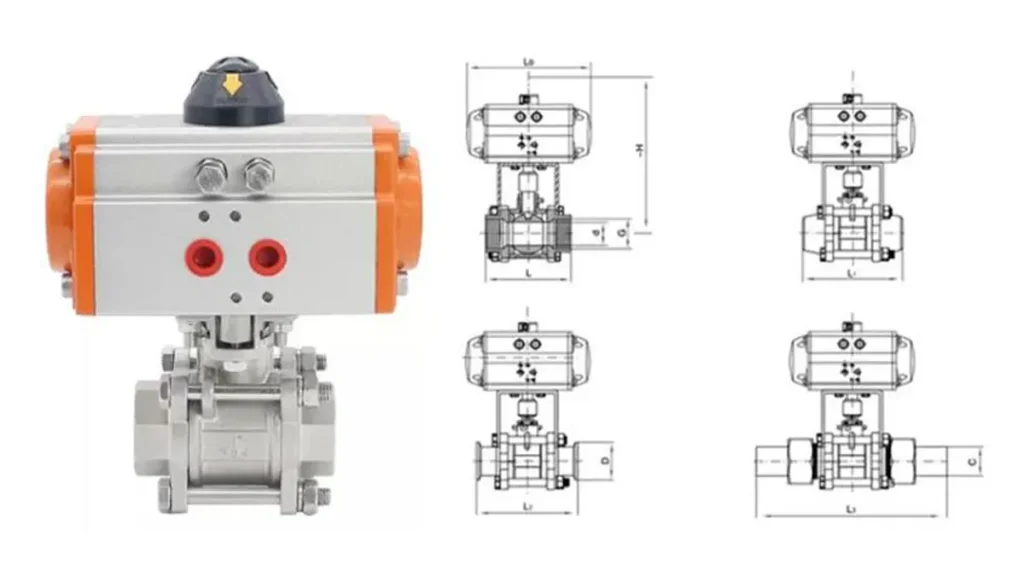
This guide covers everything you need to know about how pneumatic actuated ball valves work — including actuator types, key components, selection criteria, common problems, and how to choose the right valve for your system.
Key Takeaways
- A pneumatic actuated ball valve uses compressed air to open or close the ball valve automatically.
- The pneumatic actuator converts air pressure into rotary motion.
- The ball usually turns 90 degrees to move between the open and closed positions.
- Double-acting actuators use air to open and close the valve, while spring-return actuators use spring force to return the valve to a safe position.
- When choosing this type of valve, you should check valve size, pressure rating, actuator type, air supply pressure, connection type, material, seal compatibility, and installation space.
What Is a Pneumatic Actuated Ball Valve?
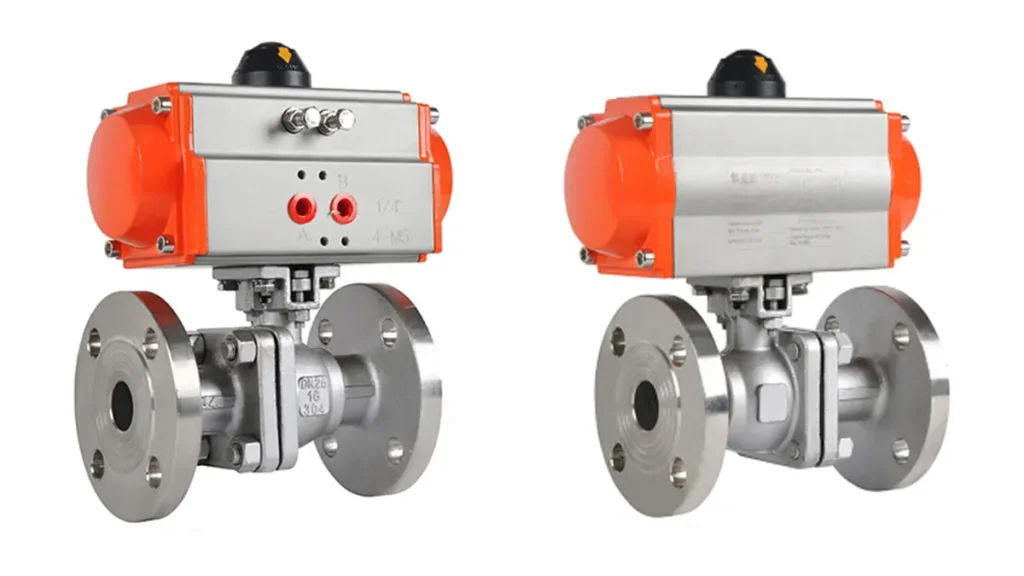
A pneumatic actuated ball valve is a valve assembly that combines two main parts: a ball valve and a pneumatic actuator.
The ball valve controls the flow of fluid. The pneumatic actuator controls the movement of the valve. When compressed air enters the actuator, the actuator turns the valve stem. The stem then rotates the ball inside the valve body to open or close the flow path.
This type of valve is also commonly called:
| Name | Meaning |
|---|---|
| Pneumatic actuated ball valve | A ball valve operated by a pneumatic actuator |
| Pneumatic ball valve | Shorter name for the same type of valve |
| Air operated ball valve | A ball valve controlled by compressed air |
| Ball valve with pneumatic actuator | A ball valve fitted with an air actuator |
| Automated ball valve | A valve used for automatic open/close control |
In hydraulic and industrial systems, pneumatic actuated ball valves are often used for automated shut-off, remote control, and fast fluid isolation. They are especially useful when the valve needs to open and close frequently, or when the installation position is hard to reach by hand.
Main Components of a Pneumatic Actuated Ball Valve
To understand the working principle, it helps to know the main parts of the valve assembly.
Ball Valve Body
The valve body holds the internal parts and connects to the pipeline or hydraulic system. It must be strong enough to handle the working pressure.
For high-pressure hydraulic applications, the valve body is usually made from strong materials such as carbon steel or stainless steel. The right material depends on the pressure, fluid, working environment, and corrosion requirements.
Ball and Stem
The ball is the part that opens or blocks the flow path. It has a hole through the center. When this hole lines up with the pipeline, fluid can pass through. When the ball rotates 90 degrees, the solid side of the ball blocks the flow.
The stem connects the ball to the actuator. When the actuator turns, the stem turns the ball.
Pneumatic Actuator
The pneumatic actuator is the part that uses compressed air to create motion. In most ball valve applications, the actuator provides rotary motion. This means it turns the valve stem instead of pushing it in a straight line.
The actuator can be double-acting or spring-return. The right choice depends on how the system should behave during normal operation or when air supply is lost.
Mounting Bracket and Coupling
The bracket connects the actuator to the valve body. The coupling connects the actuator output shaft to the valve stem.
These parts may look simple, but they are important. If the actuator and valve are not aligned correctly, the valve may not open or close smoothly.
Seats and Seals
Seats and seals help prevent leakage. They also affect pressure resistance, temperature range, and service life.
For hydraulic systems, seal material must match the working medium, pressure, and temperature. Common sealing materials may include PTFE, POM, NBR, FKM, or other materials depending on the valve design and application.
Optional Control Accessories
Some pneumatic actuated ball valves may also work with accessories such as:
| Accessory | Function |
|---|---|
| Solenoid valve | Controls air flow into the actuator |
| Limit switch | Shows whether the valve is open or closed |
| Position indicator | Gives visual position feedback |
| Air filter regulator | Helps control clean and stable air pressure |
| Control cabinet or PLC | Sends automatic control signals |
These accessories are useful for automated production lines, remote control systems, and equipment that needs position feedback.
Pneumatic Actuated Ball Valve Working Principle
The working principle is simple once you break it into steps.
A pneumatic actuated ball valve uses compressed air to move the actuator. The actuator then turns the valve stem. The stem rotates the ball inside the valve body. The ball position decides whether the flow is open or closed.
Step 1: Compressed Air Enters the Actuator
First, compressed air enters the pneumatic actuator through the air port. The air pressure pushes internal parts inside the actuator, such as pistons or racks, depending on the actuator design.
The actuator needs enough air pressure to generate the required torque. If the air pressure is too low, the actuator may move slowly or fail to open or close the valve fully.
Step 2: The Actuator Creates Rotary Motion
Inside the actuator, air pressure is converted into rotary motion. This rotary motion is what turns the valve stem.
For a ball valve, the actuator usually only needs to rotate 90 degrees. This is called quarter-turn operation. It is one reason why ball valves are widely used for quick open and close control.
Step 3: The Stem Turns the Ball
The actuator output shaft is connected to the valve stem. When the actuator rotates, the stem rotates with it.
The stem then turns the ball inside the valve body. This movement changes the position of the ball port.
Step 4: The Valve Opens or Closes
When the hole through the ball lines up with the pipeline or flow path, the valve is open. Fluid can pass through the valve.
When the ball turns 90 degrees, the hole no longer lines up with the flow path. The solid side of the ball blocks the flow, and the valve is closed.
| Valve Position | Ball Position | Flow Status |
|---|---|---|
| Open | Ball port lines up with the flow path | Fluid passes through |
| Closed | Ball port is perpendicular to the flow path | Fluid is blocked |
| Partially Open | Ball port is partly open | Limited flow, not ideal for precise control unless designed for it |
A standard ball valve is mainly used for open and close control. It can be used in a partially open position in some systems, but it is not usually the best choice for precise flow regulation. If your main goal is accurate flow adjustment, a throttle valve or flow control valve may be more suitable.
Step 5: The Control System Changes the Valve Position
The valve can be controlled by a solenoid valve, manual air switch, control cabinet, or PLC system. When the control signal changes the air direction, the actuator moves the valve to the required position.
This makes pneumatic actuated ball valves useful for automatic control systems. Operators do not need to stand next to the valve and turn a handle manually.
Double-Acting vs Spring-Return Pneumatic Actuated Ball Valves
There are two common actuator types: double-acting and spring-return.
Both can operate a ball valve, but they work differently.
| Type | How It Works | Advantages | Common Use |
|---|---|---|---|
| Double-Acting Actuator | Uses compressed air to open and close the valve | Fast response, stable operation, suitable for frequent cycling | Industrial automation, hydraulic systems, normal open/close control |
| Spring-Return Actuator | Uses air to move one direction and spring force to return | Can provide fail-safe open or fail-safe close function | Emergency shut-off, safety systems, systems that need a default position |
Double-Acting Actuator
A double-acting actuator uses air pressure for both directions. Air opens the valve, and air also closes the valve.
This type is common in systems where stable and repeatable operation is needed. It is often used in automated equipment, hydraulic oil circuits, test benches, and industrial control systems.
Spring-Return Actuator
A spring-return actuator uses air pressure to move the valve in one direction. When the air supply is removed, the spring pushes the actuator back to its original position.
This type is often used when the system needs a safety position. For example, the valve may close automatically when air pressure is lost.
The choice depends on your system design. If the valve must return to a safe position during air failure, spring-return may be better. If the system only needs normal automatic open and close control, double-acting may be enough.
Why Use a Pneumatic Actuated Ball Valve?
A pneumatic actuated ball valve is not always necessary. For simple systems, a manual ball valve may be enough. But in many industrial applications, pneumatic actuation brings clear benefits.
Fast Opening and Closing
Pneumatic actuators can open and close valves quickly. This is useful when the system needs fast shut-off or frequent operation.
Remote Operation
Some valves are installed in places that are hard to reach, unsafe, or inconvenient for manual operation. A pneumatic actuator allows the valve to be controlled from a distance.
Better Automation
Pneumatic actuated ball valves can work with solenoid valves, PLC systems, and control panels. This makes them suitable for automated production lines and hydraulic control systems.
Reduced Manual Labor
If a valve needs to open and close many times per day, manual operation can be slow and tiring. Pneumatic operation helps reduce manual work and improve consistency.
Reliable Shut-Off
Ball valves are known for simple structure and reliable shut-off. When combined with a pneumatic actuator, they can provide fast and repeatable isolation in fluid systems.
Suitable for High-Pressure Systems
For hydraulic systems and high-pressure fluid control, the valve body, sealing structure, and actuator torque must be selected carefully. A properly matched pneumatic actuated ball valve can support safe and stable operation in demanding systems.
Applications of Pneumatic Actuated Ball Valves
Pneumatic actuated ball valves are used in many industrial and hydraulic systems. Their main role is to provide automatic shut-off, remote control, or fast flow isolation.
| Application | Why It Is Used |
|---|---|
| Hydraulic Power Units | Automated oil circuit shut-off and control |
| High-Pressure Hydraulic Systems | Reliable fluid isolation under pressure |
| Industrial Equipment | Remote operation and automatic control |
| Test Benches | Fast and repeatable valve operation during testing |
| Machine Tools | Automatic hydraulic oil flow control |
| Construction Machinery | Remote or automatic hydraulic circuit control |
| Oil Circuits | Shut-off and isolation in fluid systems |
| Production Lines | Automated valve control with PLC or control cabinets |
For example, in a hydraulic power unit, a pneumatic actuated ball valve can be used to open or close an oil circuit automatically. In a test bench, it can help control test cycles more consistently. In industrial equipment, it can reduce manual operation and improve process control.
Pneumatic Actuated Ball Valve vs Manual Ball Valve
A pneumatic actuated ball valve and a manual ball valve may have a similar valve body, but the way they operate is different.
| Item | Pneumatic Actuated Ball Valve | Manual Ball Valve |
|---|---|---|
| Operation | Controlled by compressed air | Operated by hand |
| Automation | Suitable for automatic control | Not suitable for automatic control |
| Operation Speed | Fast and consistent | Depends on the operator |
| Remote Control | Possible | Not possible without extra device |
| Cost | Higher | Lower |
| Maintenance | Requires actuator and air supply checks | Simpler maintenance |
| Best For | Remote control, frequent operation, automated systems | Simple shut-off, occasional operation |
If your system only needs simple on/off control and the valve is easy to reach, a manual ball valve may be enough.
If your system needs remote control, frequent operation, automatic control, or safer operation in hard-to-reach areas, a pneumatic actuated ball valve is usually a better choice.
Key Factors When Choosing a Pneumatic Actuated Ball Valve
Choosing the right pneumatic actuated ball valve is not only about valve size. You need to match the valve and actuator to the whole system.
Valve Size
The valve size should match the pipe, hydraulic line, or connection size. It should also meet the required flow rate.
A valve that is too small may restrict flow and increase pressure drop. A valve that is too large may increase cost, weight, and installation space.
Pressure Rating
Pressure rating is very important, especially for hydraulic systems. You should confirm both the normal working pressure and the maximum pressure.
Do not use a low-pressure valve in a high-pressure hydraulic system. Even if the connection size fits, the valve may not be safe.
Actuator Type
Choose double-acting or spring-return based on your control needs.
Double-acting actuators are suitable for normal automatic open and close control. Spring-return actuators are better when the valve needs to return to a safe position when air supply is lost.
Air Supply Pressure
The actuator needs enough air pressure to operate correctly. If the air pressure is too low, the valve may not open or close fully.
Before ordering, confirm the available air supply pressure in your system.
Actuator Torque
The actuator must have enough torque to turn the valve under working conditions. High pressure, larger valve size, seal friction, and working medium can all affect the required torque.
If the actuator torque is too low, the valve may move slowly, stop halfway, or fail to close fully.
Valve Material
The valve body material should match the working environment and fluid.
Carbon steel is often used for general hydraulic oil systems. Stainless steel may be better for humid, corrosive, outdoor, or cleaner environments.
Seal Material
Seal material affects leakage performance, temperature resistance, and service life. It should match the fluid, pressure, and working temperature.
For hydraulic oil or industrial fluids, the seal material should be confirmed with the manufacturer before ordering.
Connection Type
Common connection types include threaded, flange, and customized connections. For hydraulic valves, thread standards such as BSP, NPT, or metric thread may be required.
Wrong thread standards can cause leakage, poor installation, or connection failure.
Installation Space
A pneumatic actuator takes more space than a manual handle. You should check the total height, width, actuator size, and surrounding space.
This is especially important for compact equipment, hydraulic power units, and machine installations.
Control Accessories
If the valve needs to connect with an automation system, you may need accessories such as solenoid valves, limit switches, position indicators, or air filter regulators.
These should be confirmed before ordering.
Common Problems and Troubleshooting
Pneumatic actuated ball valves are generally reliable, but problems can happen if the valve, actuator, air supply, or control system is not selected or maintained correctly.
| Problem | Possible Cause | What to Check |
|---|---|---|
| Valve does not open | Low air pressure, actuator fault, blocked air line | Air supply, tubing, solenoid valve, actuator |
| Valve does not close fully | Seal damage, stem misalignment, actuator torque too low | Seats, stem, coupling, actuator size |
| Valve moves slowly | Low air pressure, air line restriction, dirty filter | Air pressure, air filter, tubing |
| Leakage occurs | Worn seals, wrong pressure rating, damaged ball seat | Seal material, pressure, ball and seat |
| Actuator moves but valve does not | Loose coupling or damaged stem | Coupling, bracket, valve stem |
| Valve position signal is wrong | Limit switch issue or wrong wiring | Limit switch, wiring, control signal |
Many problems can be avoided by selecting the correct valve and actuator from the beginning. Regular checks of air pressure, seals, actuator movement, and control accessories can also help extend service life.
Common Mistakes When Selecting Pneumatic Actuated Ball Valves
Here are some mistakes buyers should avoid.
Only Checking Valve Size
Valve size matters, but it is not enough. You also need to check pressure rating, actuator torque, connection type, material, seals, and installation space.
Ignoring Actuator Torque
The actuator must be strong enough to turn the valve under real working conditions. If the torque is too low, the valve may fail during operation.
Choosing the Wrong Actuator Type
A double-acting actuator and a spring-return actuator are not the same. Choose the type based on your control method and safety requirements.
Ignoring Air Supply Pressure
The actuator needs stable air pressure. If the site air pressure is not enough, the actuator may not work properly.
Using a Low-Pressure Valve in a High-Pressure System
This is a serious mistake. For hydraulic systems, always confirm the valve pressure rating before ordering.
Not Checking the Connection Type
BSP, NPT, metric thread, flange, and other connection types may look similar, but they are not always interchangeable.
Ignoring Material and Seal Compatibility
The valve material and seal material must match the working medium, temperature, pressure, and environment.
Using a Ball Valve for Precise Flow Control
A ball valve is mainly used for open and close control. If your system needs accurate flow adjustment, a throttle valve or flow control valve may be more suitable.
When Do You Need a Custom Pneumatic Actuated Ball Valve?
Standard pneumatic actuated ball valves can meet many common applications. But some systems need custom solutions.
You may need a custom pneumatic actuated ball valve when your system has:
- Special pressure requirements
- Non-standard valve size
- Special thread or flange connection
- Compact installation space
- Stainless steel material requirement
- Special actuator model requirement
- Double-acting actuator requirement
- Spring-return actuator requirement
- Special bracket or coupling design
- Old valve replacement needs
- Drawings or samples that must be matched
Custom support can help make the valve fit your system more accurately and reduce installation problems.
What Information Should You Provide Before Ordering?
To help the manufacturer recommend the right pneumatic actuated ball valve, prepare the key system details before requesting a quote.
| Information | Why It Matters |
|---|---|
| Valve size | Helps match the pipeline or hydraulic line |
| Working pressure | Determines valve pressure rating |
| Maximum pressure | Helps confirm safety margin |
| Fluid type | Affects material and seal selection |
| Temperature range | Affects seal and body material |
| Connection type | Ensures correct installation |
| Air supply pressure | Helps select the actuator |
| Actuator type | Double-acting or spring-return |
| Operation frequency | Helps check actuator suitability |
| Installation space | Confirms actuator and valve dimensions |
| Drawings or samples | Useful for custom or replacement valves |
The more details you provide, the easier it is to select the right valve.
Conclusion
A pneumatic actuated ball valve uses compressed air to drive an actuator, which rotates the ball 90 degrees inside the valve body to open or close the flow path. It is a reliable, fast, and automation-friendly solution for industrial pipelines, hydraulic systems, and remote-controlled equipment.
Compared to a manual ball valve, pneumatic actuation offers faster response, remote operability, and better compatibility with automated control systems — making it the right choice for applications where frequent operation, safety positioning, or hands-free control is required.
When selecting a pneumatic actuated ball valve, valve size is only one part of the decision. Make sure you also confirm pressure rating, actuator type, air supply pressure, actuator torque, connection standard, body material, and seal compatibility before ordering.
If you are unsure which configuration fits your system, the section above outlines the key information to prepare before contacting a manufacturer.
FAQ
What is a pneumatic actuated ball valve?
A pneumatic actuated ball valve is a ball valve operated by a pneumatic actuator. It uses compressed air to open or close the valve automatically.
How does a pneumatic actuated ball valve work?
Compressed air enters the pneumatic actuator and creates rotary motion. The actuator turns the valve stem, and the stem rotates the ball inside the valve body. When the ball port lines up with the flow path, the valve opens. When the ball turns 90 degrees, the valve closes.
What is the difference between a pneumatic actuated ball valve and a manual ball valve?
A pneumatic actuated ball valve is operated by compressed air and can be used in automated systems. A manual ball valve is opened and closed by hand. Pneumatic actuated valves are better for remote control, frequent operation, and automation.
What is the difference between double-acting and spring-return actuators?
A double-acting actuator uses air pressure to open and close the valve. A spring-return actuator uses air to move the valve in one direction and spring force to return it when air pressure is lost.
Can pneumatic actuated ball valves be used in hydraulic systems?
Yes, they can be used in hydraulic systems if the valve body, pressure rating, seal material, connection type, and actuator torque are suitable for the working conditions.
Are pneumatic actuated ball valves used for flow control?
They are mainly used for open and close control. Some systems may use them in a partially open position, but for accurate flow regulation, a throttle valve or flow control valve is usually a better choice.
What information should I provide for a quote?
You should provide valve size, working pressure, maximum pressure, fluid type, temperature, connection type, air supply pressure, actuator type, material requirements, drawings, or samples.
Looking for a Pneumatic Actuated Ball Valve for Your System?
Chenyang Hydraulic manufactures hydraulic ball valves with pneumatic actuators for high-pressure hydraulic systems, industrial equipment, oil circuits, and automated fluid control applications. Whether you need a standard configuration or a custom solution based on your pressure rating, valve size, connection type, actuator type, or installation drawings, our team can help you find the right fit.
Request a Quote