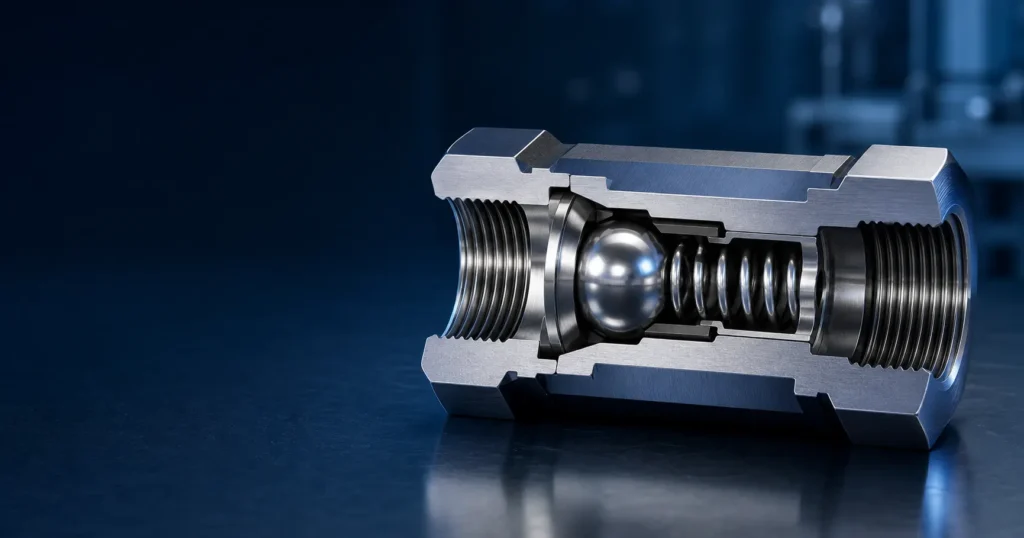
A ball check valve is an automatic one-way valve that uses a ball as the closing element. Forward pressure moves the ball away from the seat and allows fluid to pass. When flow stops or reverses, the ball returns to the seat and blocks backflow. Some ball check valves use a spring, while others depend mainly on gravity and reverse pressure.
Key Takeaways
- A ball check valve uses a movable ball to allow one-way flow and stop reverse flow.
- It operates automatically and normally has no handle or external actuator.
- Ball check valves may be gravity-assisted, reverse-flow operated, or spring-loaded.
- A ball check valve is not the same as a quarter-turn ball valve.
- The ball, seat, guide, spring, body, and seals affect leakage, pressure drop, and service life.
- Hydraulic applications require confirmation of pressure rating, flow, cracking pressure, fluid, connection, and installation orientation.
What Is a Ball Check Valve?
A ball check valve is a type of non-return valve in which the movable sealing element is a ball. The valve permits fluid to move from the inlet to the outlet but closes when the fluid attempts to move in the opposite direction.
The ball sits against a shaped seat. When forward pressure produces enough force, the ball moves away from the seat and opens a flow path. When the pressure difference decreases or reverses, the ball returns to the seat.
Depending on the design, the ball may be guided by an internal cage or passage. It may be pushed toward the seat by a spring, by gravity, by reverse pressure, or by a combination of these forces.
How Does a Ball Check Valve Work?
Closed Position
With no forward pressure, the ball rests against the seat. In a spring-loaded design, the spring actively pushes the ball toward the seat. In a gravity design, the valve orientation and ball weight help position the ball.
Opening During Forward Flow
Fluid entering from the permitted direction acts on the exposed area of the ball. When the pressure difference overcomes the ball weight, spring force, downstream pressure, and friction, the ball lifts or moves away from the seat.
Closing During Reverse Flow
When forward flow falls, the ball begins to return. Reverse pressure then pushes the ball against the seat and blocks the reverse path. A correctly matched ball and seat are essential for consistent sealing.
Ball Check Valve Components
Valve Body
The body forms the pressure-containing shell and contains the internal flow passage. It may use threaded, flanged, cartridge, tube, or special connections depending on the application.
Ball
The ball is the movable closing element. It may be made from steel, stainless steel, polymer, elastomer-covered material, ceramic, or another material selected for pressure, wear, corrosion, and fluid compatibility.
Valve Seat
The seat is shaped to guide and seal against the ball. Surface finish, concentricity, hardness, and material compatibility affect leakage and durability.
Spring or Guide
A spring may control the cracking pressure and improve closing response. A guide or cage keeps the ball from moving into an unstable position and helps maintain a predictable flow path.
Seals
Static seals prevent leakage between body parts. Their material must match the hydraulic fluid, temperature, pressure, and environment.
Spring-Loaded vs Gravity Ball Check Valves
| Feature | Spring-Loaded Ball Check | Gravity Ball Check |
| Closing force | Spring plus reverse pressure | Ball weight plus reverse pressure |
| Cracking pressure | Influenced strongly by spring preload | Influenced by ball weight, orientation, and pressure |
| Mounting orientation | Often more flexible, subject to design | Usually more dependent on orientation |
| Closing response | Spring can help the ball return quickly | Depends more on gravity and reverse flow |
| Typical use | Compact hydraulic, pneumatic, and process circuits | Pumps, drainage, wastewater, and suitable process piping |
Important: The term ball check valve describes the closing element. It does not tell you whether the valve uses a spring. Always confirm the internal design.
Ball Check Valve vs Ball Valve
These two names are easy to confuse, but the valves have different functions.
| Comparison | Ball Check Valve | Ball Valve |
| Main purpose | Automatically prevents reverse flow | Starts, stops, or diverts flow |
| Ball movement | Ball lifts or shifts away from a seat | Ball rotates approximately 90 degrees |
| Operation | Automatic pressure-operated action | Manual handle or actuator |
| Flow direction | Normally one permitted direction | Often bidirectional, depending on design |
| Control function | Backflow prevention | On/off isolation or flow path selection |
Note: A ball check valve should not be selected as a replacement for a hydraulic ball valve used for manual shut-off.
Ball Check Valve vs Poppet Check Valve
Ball and poppet check valves perform the same basic one-way function, but their sealing elements and guidance are different.
| Factor | Ball Check Valve | Poppet Check Valve |
| Closing element | Spherical ball | Guided cone, disc, or shaped poppet |
| Guidance | May have limited or cage-guided movement | Usually guided along a defined axis |
| Sealing | Depends on ball and seat contact | Shaped sealing geometry can provide controlled contact |
| Application tendency | Simple compact circuits and general backflow prevention | Often selected where repeatable guidance or low leakage is important |
| Selection focus | Ball material, seat, orientation, spring | Poppet geometry, guide, spring, seat, flow area |
Neither design is automatically best for every system. The correct choice depends on working pressure, allowable leakage, contamination level, response, flow rate, pressure drop, installation, and cost.
Advantages of Ball Check Valves
- Simple internal structure with a small number of moving parts.
- Automatic one-way operation without a handle or actuator.
- Compact designs are available for small hydraulic circuits and manifolds.
- The ball can align with a properly designed seat to block reverse flow.
- Spring-loaded versions can provide controlled cracking pressure and faster return.
- Different ball and seat materials can be selected for different fluids and environments.
Limitations and Risks
- The internal passage and partially open ball can create pressure drop.
- Contamination may become trapped between the ball and seat and cause leakage.
- An unguided ball may move irregularly under unstable or pulsating flow.
- Gravity-assisted designs may be sensitive to installation orientation.
- A damaged, worn, corroded, or deformed seat can reduce sealing performance.
- Ball check valves may not provide the leakage control required by every high-pressure system.
Where Are Ball Check Valves Used?
Small and Medium Hydraulic Circuits
Compact ball check valves may be used for basic reverse-flow protection in control lines, lubrication systems, jacks, power units, and general hydraulic pipelines.
Pump Inlet or Outlet Circuits
A suitable ball check valve may help maintain fluid direction around a pump. Pump pulsation, suction conditions, pressure rating, ball movement, and flow resistance must be evaluated.
Bypass Circuits
A ball check valve can provide a free-flow direction around a throttle or another circuit element while blocking flow in the opposite direction.
Lubrication and Dosing Systems
Small ball check valves are often used where a compact one-way element is needed to maintain fluid direction during repeated pumping or dosing cycles.
Industrial and Mobile Equipment
Depending on pressure and flow requirements, ball check valves may be found in agricultural machinery, material-handling equipment, machine tools, compact hydraulic units, and other industrial systems.
How to Select a Hydraulic Ball Check Valve
- Define the function: basic backflow prevention, pump protection, bypass, makeup flow, or another circuit function.
- Confirm normal working pressure, maximum pressure, and pressure spikes.
- Provide the required flow rate and allowable pressure drop.
- Confirm whether the valve is gravity-assisted or spring-loaded.
- Specify the required cracking pressure if a spring is used.
- Match the connection standard, size, sealing method, and available installation space.
- Confirm hydraulic fluid, temperature, ball material, body material, seat, and seal compatibility.
- Check mounting orientation and the marked flow direction.
- Provide leakage requirements and cycle frequency.
- Send a drawing, sample, schematic, or existing model when dimensions or internal performance are critical.
Common Ball Check Valve Problems
The Valve Does Not Open
Possible causes include reverse installation, insufficient inlet pressure, excessive spring preload, a blocked passage, contamination, or a ball stuck against the seat.
The Valve Leaks Backward
Contamination on the seat, ball damage, seat wear, corrosion, seal failure, or insufficient closing force may allow reverse leakage.
The Valve Chatters or Makes Noise
Unstable flow, an oversized valve, pulsation, insufficient opening pressure, incorrect orientation, or ball movement inside the chamber may produce noise or repeated opening and closing.
Pressure Drop Is Too High
The valve may be undersized, partly open, contaminated, fitted with a spring that is too strong, or operating with fluid that is more viscous than expected.
Common Selection Mistakes
- Confusing a ball check valve with a quarter-turn ball valve.
- Assuming every ball check valve has a spring.
- Ignoring mounting orientation in gravity-assisted designs.
- Selecting only by thread size without checking flow capacity.
- Using a general ball check valve where very low leakage or secure load holding is required.
- Failing to confirm ball, seat, body, and seal compatibility.
- Ignoring contamination control and filtration.
Conclusion
A ball check valve is an automatic one-way valve that uses a ball to open the forward flow path and seal against reverse flow. It is different from a hydraulic ball valve, which rotates a drilled ball to provide manual or actuated shut-off.
Before selecting a ball check valve, confirm whether it is gravity-assisted or spring-loaded. Then check pressure, flow, pressure drop, cracking pressure, leakage, material, fluid, temperature, connection, orientation, and contamination conditions.
Chenyang Hydraulic can review check valve requirements using your operating data, drawing, sample, or model reference. This is especially important when the application requires non-standard dimensions, specific cracking pressure, material changes, or OEM production.
Frequently Asked Questions
Is a ball check valve the same as a ball valve?
No. A ball check valve automatically prevents reverse flow by moving a ball onto a seat. A ball valve rotates a ball with a bore to start or stop flow.
Does every ball check valve use a spring?
No. Some ball check valves are spring-loaded, while others rely mainly on gravity, ball weight, and reverse pressure.
Can a ball check valve be installed horizontally?
A spring-loaded design may support horizontal installation, but a gravity-assisted design can be orientation-sensitive. Always confirm the manufacturer’s installation requirements.
What causes a ball check valve to leak?
Common causes include contamination on the seat, a scratched or deformed ball, seat wear, corrosion, seal damage, insufficient closing force, or incorrect installation.
Does a ball check valve reduce flow?
Yes. The ball, seat, spring, and internal passage create resistance. Correct sizing helps keep the pressure drop within an acceptable range.
Which is better, a ball or poppet check valve?
It depends on the application. Ball designs are simple and compact, while guided poppet designs are often considered where stable guidance, high pressure, or low leakage is important.
Can a ball check valve hold a hydraulic load?
A basic ball check valve may block reverse flow, but load-holding safety must be evaluated separately. A pilot-operated check valve or counterbalance valve may be required.