
Hydraulic valves control one or more of three things: where oil flows, how much pressure the circuit develops, and how much flow reaches an actuator. That gives you three main functional families: directional-control, pressure-control, and flow-control valves. Check valves and shut-off valves sit within the directional family, but they are often treated separately because their jobs are simple and common.
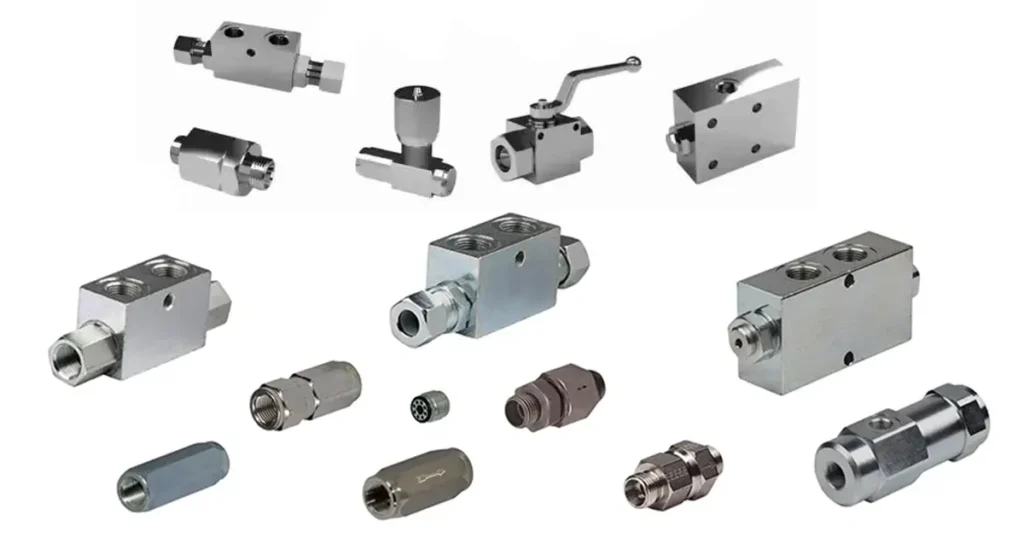
That three-family list is only a starting point. Two valves with the same general name can differ in internal construction, actuation, mounting, leakage, pressure drop, and response. If you are selecting a replacement or requesting a quote, the function and operating conditions matter more than the label on the old part.
The three main hydraulic valve families
| Family | What it controls | Common examples | Main selection risk |
|---|---|---|---|
| Directional control | Which path the fluid takes | Spool valves, poppet valves, check valves, shuttle valves, shut-off valves | Wrong port/position logic or unsafe neutral state |
| Pressure control | Pressure in the system or a branch | Relief, reducing, sequence, unloading, counterbalance valves | Wrong setting, stability, drain routing, or load-control function |
| Flow control | Flow rate and therefore actuator speed | Fixed orifices, needle valves, throttle valves, compensated flow controls, flow dividers | Excess pressure drop, heat, or speed variation as load changes |
ISO 5598:2020 provides standardized fluid-power vocabulary, while circuit symbols are governed through the ISO 1219 series. Those standards help teams use consistent terms, but they do not replace the valve?s application data sheet.
Directional-control valves
A directional valve opens, closes, or redirects a flow path. You choose it by the number of ports, number of positions, center condition, actuation method, and required flow paths.
Spool directional valves
A spool slides inside a closely fitted bore. Lands on the spool open and block different internal passages as the spool moves. This construction supports several flow paths in one compact valve, which is why it is common in cylinder and motor circuits.
Spool valves normally allow some internal leakage through running clearances. That does not automatically mean the valve is defective. The acceptable rate depends on the design, fluid viscosity, temperature, pressure differential, and manufacturer?s specification.
Poppet directional valves
A poppet moves toward or away from a seat. A well-matched seat and closure element can provide tighter shut-off than a sliding spool, but the valve may require more force to open against pressure. Pilot operation is often used when direct actuation force would be too high.
Check valves
A check valve passes flow in one direction and resists reverse flow. The basic selection variables are working pressure, forward flow, pressure drop, cracking pressure, connection, fluid, seal material, and reverse-leakage requirement.
A standard inline hydraulic check valve is not automatically a load-holding valve. Suspended or overrunning loads may require a pilot-operated check, counterbalance function, redundancy, or another safety measure chosen through the machine risk assessment.
Shut-off and ball valves
Shut-off valves isolate part of a circuit for operation or service. A hydraulic ball valve uses a rotating ball with a through-bore and normally reaches the fully open or fully closed state with a quarter turn. Its open flow path can produce low pressure drop when the bore and porting are properly sized.
Do not use a standard ball valve as a precision speed control. Holding the ball partly open concentrates velocity at the edges of the bore and may damage seats, generate heat, and make the flow setting unstable. Use a valve designed for throttling when you need repeatable metering.
Pressure-control valves
Pressure-control valves respond to hydraulic force acting against a spring, pilot pressure, or another control force. Their names sound similar, but the circuit jobs are different.
| Type | Primary job | Normally open or closed | Important question |
|---|---|---|---|
| Relief valve | Limits maximum pressure by diverting flow | Normally closed | What is the pressure override as flow rises? |
| Pressure-reducing valve | Maintains a lower pressure downstream | Normally open | Does it require an external drain? |
| Sequence valve | Starts a second function after pressure reaches a set value | Normally closed | How does downstream back pressure affect the setting? |
| Unloading valve | Routes pump flow to tank at low pressure when commanded | Application dependent | What pressure signal opens and resets it? |
| Counterbalance valve | Controls an overrunning load and maintains back pressure | Normally closed | What pilot ratio and setting suit the load? |
Chenyang?s current published product range focuses on ball, shut-off, check, throttle, and related flow-control products. The pressure-control types above are included to explain the full classification; do not assume every type discussed here is a Chenyang product.
Flow-control valves
Actuator speed depends on flow. A cylinder?s ideal velocity is flow divided by effective piston area, while a motor?s ideal speed depends on flow divided by displacement. A flow-control valve changes that flow, but the circuit and load decide whether the speed remains stable.
Fixed orifice
A fixed opening is simple and tamper resistant. Flow changes with the pressure differential across the orifice and with fluid properties, so it works best where operating conditions stay within a narrow range.
Adjustable throttle or needle valve
An adjustable restriction changes the flow area. Chenyang?s hydraulic throttle valves are relevant when you need manual adjustment and the circuit can tolerate flow variation as load or viscosity changes.
A one-way throttle combines an adjustable restriction with a reverse-flow check path. A bidirectional throttle meters both directions. The choice depends on whether the actuator should move slowly in one direction and return freely, or whether both movements need control.
Pressure-compensated flow control
A compensator attempts to maintain a controlled pressure differential across the metering orifice. That reduces flow variation when load pressure changes, provided the valve has enough pressure margin to regulate. If the available differential falls below the compensator requirement, the commanded flow cannot be maintained.
Use a hydraulic flow control valve when you need more stable actuator speed than a simple restriction can provide. Evaluate the actual pressure-drop-versus-flow data rather than relying on a nominal port size.
Classify valves by construction
Function tells you what the valve does. Construction tells you how it does it and strongly influences leakage, contamination sensitivity, pressure capability, and operating force.
| Construction | Strength | Trade-off | Typical use |
|---|---|---|---|
| Spool | Multiple paths and proportional metering are possible | Running clearance creates internal leakage and sensitivity to contamination | Directional and proportional control |
| Poppet | Compact seat and potentially tight closure | Pressure forces can increase actuation demand | Check, logic, and seat valves |
| Ball | Fast quarter-turn isolation and a direct bore | Ordinary designs are not intended for precision throttling | Shut-off and flow switching |
| Needle | Fine manual adjustment of a small flow area | Creates pressure loss and heat; setting may be load sensitive | Throttle and speed adjustment |
| Cartridge | Compact installation inside a manifold cavity | Cavity geometry and cleanliness are critical | Integrated control manifolds |
| Plate or subplate mounted | Easy circuit stacking and standardized interfaces | Interface pattern and seal locations must match | Industrial valve stacks |
| Inline or threaded | Simple installation in a pipe or hose run | Thread standard, orientation, and service access matter | Check, shut-off, and flow-control lines |
Classify valves by actuation
Manual valves use a lever, knob, handwheel, or push control. Mechanical valves use cams, rollers, or linkages. Solenoid valves convert electrical input into movement. Hydraulic and pneumatic pilot valves use pressure to shift a larger control element. Proportional and servo valves modulate position rather than simply switching between states.
Do not choose actuation in isolation. Check available control power, required response, fail state, environment, duty cycle, manual override, access for service, and what the machine must do when electrical or pilot pressure is lost.
Meter-in, meter-out, and bleed-off are circuit choices
These terms describe where the flow-control function sits, not three different internal valve families.
- Meter-in restricts flow entering the actuator. It can work with resisting loads but may not control an overrunning load.
- Meter-out restricts flow leaving the actuator. It creates back pressure and can improve control of an overrunning load, but pressure intensification must be checked.
- Bleed-off diverts part of the pump flow to tank. It may waste less energy than forcing excess pump flow across a relief valve, but performance depends on the system architecture.
For hazardous loads, flow control is not a substitute for a properly designed load-holding and safety circuit. Apply the general safety principles in ISO 4413 and the machine-specific risk assessment.
How to choose the right hydraulic valve type
- Define the job: isolate, prevent reverse flow, select a path, limit pressure, reduce pressure, or control actuator speed.
- Draw the required normal state and failure state. Decide what must happen when power or pilot pressure disappears.
- Calculate required flow for the desired cylinder or motor speed.
- Check working pressure, expected peaks, and pressure at every port, including tank and pilot drains.
- Review pressure drop at operating flow. ISO 4411:2019 describes the determination of differential-pressure/flow characteristics for hydraulic valves.
- Set a realistic leakage requirement. Distinguish internal leakage from external leakage.
- Match connection and mounting: NPT, BSP, SAE, metric thread, flange, inline, block, or plate interface.
- Confirm fluid, viscosity range, temperature, seal compatibility, contamination level, and corrosion exposure.
- Check actuation force, control signal, response time, duty cycle, and service access.
- Use the complete circuit and product data sheet to confirm the final selection.
Selection shortcuts that often fail
Matching only the thread size can give you a valve with excessive pressure drop. Matching only the pressure rating can miss reverse-flow restrictions or unacceptable leakage. Replacing a throttle with a ball valve gives you poor speed control. Replacing a load-control valve with a basic check valve can create a serious safety problem. And choosing a larger valve ?for safety? can reduce adjustment resolution or make the package unnecessarily heavy and expensive.
FAQ
What are the three main types of hydraulic valves?
The three main functional groups are directional-control, pressure-control, and flow-control valves. Shut-off and check valves are directional functions that are often discussed as separate practical categories.
What valve controls hydraulic cylinder speed?
A flow-control or throttle valve controls the flow that determines cylinder speed. Choose between non-compensated and pressure-compensated control based on how much the load and available pressure change.
What is the difference between a spool valve and a poppet valve?
A spool slides inside a bore to connect several flow paths. A poppet opens away from a seat. Spool designs support complex routing and metering, while seat-type designs can provide tighter closure in suitable applications.
Is a hydraulic ball valve a flow-control valve?
It controls whether flow passes, but a standard hydraulic ball valve is mainly a shut-off or switching valve. It should not be treated as a precision throttling valve unless the product is specifically designed and rated for that service.
What information is needed to select a hydraulic valve?
Provide the circuit function, working and peak pressure, flow, allowable pressure drop, port standard, fluid, temperature, materials, leakage requirement, actuation, mounting space, quantity, and any drawing or current model number.
Send the circuit, not just the old valve name
If your application needs a ball valve, shut-off valve, inline check valve, or throttle/flow-control product, Chenyang Hydraulic can review the function against its current product range. Send the schematic, working conditions, connection standard, material preference, and quantity through the Chenyang Hydraulic contact page.