
A hydraulic shut-off valve opens, closes, or isolates hydraulic oil flow in a system. That’s it — stop the flow when you need to, let it through when you don’t. This guide is for engineers, buyers, maintenance teams, and equipment manufacturers who need to understand shut-off valve function, types, selection criteria, and common mistakes.
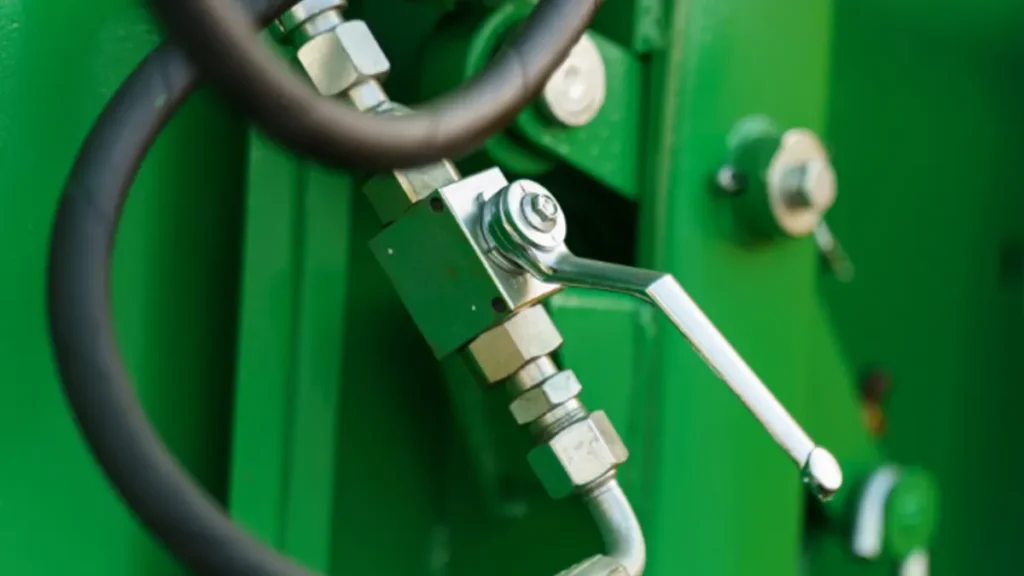
Whether you’re designing a hydraulic power unit, specifying parts for mobile equipment, or sourcing valves for an industrial setup, knowing the shut-off valve’s role — and how to pick the right one — saves time, money, and safety headaches.
What Is a Hydraulic Shut-Off Valve?
A hydraulic shut-off valve is a mechanical device that blocks or allows hydraulic fluid flow through a pipe or hose. Unlike flow control valves that regulate flow rate or directional valves that route flow to different paths, shut-off valves work in binary — fully open or fully closed.
The basic parts: a valve body with inlet and outlet ports, a closing element (ball, gate, needle, or poppet), a seal mechanism, and an operating handle or actuator. Turn the handle, and the internal element either lines up with the flow path (open) or blocks it (closed).
Note: Many hydraulic ball valves work as shut-off valves, but not all shut-off valves are ball valves. “Hydraulic shut-off valve” covers a broader set of valve types designed for isolation.
You’ll find these valves at strategic points in hydraulic systems — before and after pumps, filters, accumulators, cylinders, and motors. They let you break the system into serviceable chunks without draining the whole thing.
Main Functions of a Hydraulic Shut-Off Valve
Oil Circuit Isolation
This is the main job. Positioned right, a shut-off valve divides a system into independent hydraulic zones. You can shut down one section and keep others running. That’s critical in multi-function equipment where a full system shutdown isn’t practical.
Maintenance and Repair Safety
During service work, shut-off valves save you from draining the entire reservoir. Close the valve to isolate a component — cylinder, motor, hose — and work on it while the rest of the system stays pressurized. Less fluid waste, less downtime, faster repairs.
Emergency Shut-Off
A ruptured hydraulic line or failed component turns ugly fast. A properly placed shut-off valve stops fluid loss immediately, contains the damage to one circuit, and prevents oil spills. On mobile equipment in remote areas, that can save the job.
Pressure Holding and Leakage Control
Good shut-off valves hold pressure on one side while the other side is vented or serviced. The internal seal stops oil from leaking past the closed position. That’s essential for accumulator isolation — you need to trap pressure for emergency use or controlled release.
Equipment Protection
Isolate sensitive components from pressure spikes or contamination during startup and shutdown. Shut-off valves act as a barrier. They prevent reverse flow that could damage pumps and reduce wear on seals and gaskets during cycling.
How Does a Hydraulic Shut-Off Valve Work?
Pretty simple: turn the handle, and the internal mechanism opens or closes the flow path.
Most manual hydraulic shut-off valves use a 90-degree rotation. In a ball valve, the handle connects to a stem that rotates a ball with a bore through its center. Handle parallel to the pipe — the bore aligns with the flow path, fluid passes through. Turn it 90 degrees perpendicular — the solid part of the ball blocks the flow completely.
Sealing happens when the ball (or gate, or needle tip) presses against a seat inside the valve body. In many designs, higher system pressure actually improves the seal — pressure forces the closing element tighter against the seat.
For actuated valves (electric, hydraulic, or pneumatic), the same 90-degree rotation is driven by a motor or cylinder. Same function — full open or full close — but with remote or automated control.
Common Types of Hydraulic Shut-Off Valves
Hydraulic Ball Valves
The most common type. A ball with a machined bore rotates 90 degrees to open or close. Ball valves offer full port flow (no restriction when open), quick quarter-turn operation, and reliable sealing. They handle high pressures and come in a wide range of sizes, materials, and connection types.
Best for: General-purpose isolation, high-flow applications, frequent operation.
Manual Shut-Off Valves
Simple manually operated valves with a handle or knob. They include hand-operated ball valves but also cover gate and globe valves. No power source needed — the most cost-effective option when automation isn’t required.
Best for: Simple on/off control, non-critical circuits, tight budgets.
Needle Valves
A tapered needle-shaped plunger fits into a matching seat. Turning the handle moves the needle in and out, gradually opening or closing the path. Needle valves give you finer control than ball valves, but they’re typically used in smaller lines and for gauge isolation.
Best for: Small-diameter lines, instrument isolation, applications that need metering plus shut-off.
Poppet Type Shut-Off Valves
A disc or cone-shaped element (the poppet) lifts off a seat to allow flow and presses against it to block flow. Poppet valves seal well even with dirty oil because the poppet can push through debris. They’re common in cartridge-style designs.
Best for: Contaminated fluid, high-pressure circuits, cartridge manifold systems.
Cartridge Shut-Off Valves
Cartridge valves thread or press into a machined cavity in a manifold block. Compact installation, fewer leakage paths (less pipe connections), and easy replacement without disturbing the manifold. Most are poppet or ball type designs in cartridge format.
Best for: Compact manifold systems, mobile equipment, high-density circuits.
Custom Hydraulic Shut-Off Valves
Sometimes standard valves don’t cut it — unusual port sizes, special materials, non-standard pressure ratings, unique connection configs. Custom shut-off valves fill that gap. Manufacturers like Chenyang Hydraulic make custom valves machined to your specs, drawings, or samples.
Best for: Non-standard applications, OEM equipment, retrofit projects with existing mounting constraints.
Hydraulic Ball Valve vs Needle Valve vs Poppet Valve
| Valve Type | Main Function | Flow Control | Pressure Suitability | Common Application |
|---|---|---|---|---|
| Ball Valve | On/off isolation | Full open or closed, no throttling | Up to 10,000+ PSI | General hydraulic systems, HPUs, high-flow lines |
| Needle Valve | Shut-off + fine metering | Variable, precise | Up to 6,000 PSI | Gauge isolation, small lines, instrument panels |
| Poppet Valve | On/off isolation, leak-tight | Open or closed, works with dirty fluid | Up to 5,000 PSI | Contaminated systems, cartridge manifolds |
Tip: Start with a ball valve for most shut-off needs. It gives you the best mix of flow capacity, pressure rating, and reliability for the price. Switch to needle valves only when you also need fine metering. Go poppet only when contamination resistance is a priority.
Key Specifications to Check Before Buying
Before you pick a valve, run through these specs:
| Specification | What It Means |
|---|---|
| Pressure Rating | Max working pressure. System operating pressure must be below this. |
| Valve Size | Port size (NPT, BSP, SAE, flange). Must match your piping or hose. |
| Port Size | Internal diameter of the port opening — affects flow capacity (Cv). |
| Connection Type | NPT, BSPP, BSPT, SAE O-ring, JIC, ORFS, or flange. Must match your fittings. |
| Body Material | Carbon steel, stainless steel, brass, or aluminum. Determines corrosion resistance and strength. |
| Seal Material | NBR (Buna-N), FKM (Viton), EPDM, PTFE. Must be compatible with your fluid. |
| Flow Direction | Some valves are uni-directional (marked). Others work both ways. |
| Temperature Range | Must cover your system’s min and max temps. |
| Working Medium | Mineral oil, water-glycol, phosphate ester, etc. Affects seal and body material choice. |
Material and Seal Options
| Material / Seal | Features | Suitable Applications |
|---|---|---|
| Carbon Steel Body | High strength, cost-effective, moderate corrosion resistance | Standard hydraulic systems, HPUs, construction equipment |
| Stainless Steel Body | Excellent corrosion resistance, food-grade options | Marine, food processing, chemical, offshore |
| Brass Body | Good corrosion resistance, lower pressure rating | Low-pressure systems, water-based fluids, instrumentation |
| Aluminum Body | Lightweight, good corrosion resistance | Mobile equipment, aerospace, weight-sensitive apps |
| NBR (Buna-N) Seals | Good oil resistance, -40°C to +100°C, low cost | Standard mineral hydraulic oils, general industrial |
| FKM (Viton) Seals | High temp resistance, chemical resistance | High-temp systems, phosphate ester fluids, aggressive chemicals |
| PTFE Seals | Universal chemical compatibility, low friction | High-temp, high-purity, aggressive fluid applications |
Common Applications of Hydraulic Shut-Off Valves
You’ll find shut-off valves in nearly every pressurized fluid system:
Hydraulic Power Units (HPUs) — Shut-off valves on pump discharge lines, return lines, and accumulator circuits let you do maintenance without draining the tank.
Construction Machinery — Excavators, loaders, bulldozers use shut-off valves to isolate specific hydraulic functions for field repairs. Fix the boom cylinder without losing the track drive.
Agricultural Machinery — Tractors, harvesters, sprayers use shut-off valves at quick-connect couplers and implement circuits. Swap attachments without dumping oil.
Machine Tools — CNC lathes, mills, presses use shut-off valves to isolate lubrication and coolant circuits during maintenance.
Test Benches — Hydraulic test systems use shut-off valves to switch between test circuits and protect instruments from overpressure.
Industrial Equipment — Presses, injection molding machines, automated assembly lines rely on shut-off valves for circuit isolation and process control.
Mobile Equipment — Trucks, cranes, aerial work platforms use shut-off valves for safety interlocks and emergency stops.
Installation and Maintenance Tips
Before you start:
- Depressurize the system completely. Never install on a pressurized line — it’s asking for trouble.
- Confirm connection type and thread standard match your fittings. NPT and BSP threads look similar but won’t thread together properly.
- Check for a flow direction arrow on the valve body. Some valves are directional.
- Make sure there’s enough clearance for full 90-degree handle rotation. Tight spaces can prevent the valve from closing all the way.
During installation:
- Use thread sealant (for NPT) or O-rings (for SAE/BSPP connections). Don’t overtighten — you can crack the valve body.
- Orient the valve so handle position clearly shows open/closed. Parallel to pipe = open. Perpendicular = closed. Simple.
After installation:
- Leak test at system pressure before putting the circuit in service.
- Cycle the valve open and closed a few times to seat the seals.
Regular maintenance:
- Cycle shut-off valves that stay in one position for months — once a month prevents seals from sticking or deforming.
- Check for external leaks around the stem and body joints.
- If the handle feels stiff, contamination in the bore or damaged seals could be the cause.
- Replace seals at intervals recommended by the manufacturer or based on system hours.
Common Selection Mistakes
Choosing only by size. Port size matters, but pressure rating and material matter just as much. A valve that fits the pipe but can’t handle the pressure will fail.
Ignoring pressure rating. Using a 1,500 PSI valve in a 3,000 PSI system is a safety hazard waiting to happen.
Mixing thread standards. NPT and BSP threads have different angles (60° vs 55°) and pitch. Forcing them together damages threads and causes leaks. Always verify.
Using low-pressure valves in hydraulic systems. A standard water ball valve looks like a hydraulic ball valve but isn’t built for hydraulic pressures and shock loads. Use valves specifically rated for hydraulic service.
Ignoring seal compatibility. Not all seals work with all fluids. Phosphate ester fluids destroy standard Buna-N seals. Match the seal to your fluid.
Not checking drawings or samples. Assuming a standard valve fits without checking actual mounting space, port orientation, and handle clearance leads to returns and delays.
How to Choose the Right Hydraulic Shut-Off Valve
Follow these steps:
- Determine system pressure — Pick a valve rated at least 1.5x your system’s max operating pressure.
- Calculate flow requirements — Match valve size to your pipe or hose size. Undersized valves create restrictions and pressure drop.
- Select connection type — Match your existing fitting standard: NPT, BSP, SAE O-ring, ORFS, or flange.
- Choose body material — Carbon steel for standard use. Stainless for corrosive environments. Brass or aluminum for low-pressure or lightweight needs.
- Verify seal compatibility — Buna-N for standard mineral oils. Viton for high temps or aggressive fluids. PTFE for universal compatibility.
- Check installation space — Measure clearance for the handle and verify access.
- Review drawings or provide samples — For custom or replacement valves, share the original part or a dimensioned drawing with the manufacturer.
Tip: Not sure about a spec? Send a clear photo of your current valve (with dimensions) or the system schematic to your valve supplier. Most reputable manufacturers — including Chenyang Hydraulic — can match or recommend the right valve from specs or samples.
Conclusion
Hydraulic shut-off valves do one simple thing — they control where and when hydraulic fluid flows. Understanding the core functions (isolation, safety, emergency shutdown, system protection), the different types (ball, needle, poppet, cartridge), and the key specs to check before buying (pressure, size, connection, material, seals) means you can pick the right valve and avoid costly mistakes.
As a hydraulic valve manufacturer, Chenyang Hydraulic offers standard and custom hydraulic shut-off valves to meet your system requirements. Need a ball valve for general isolation? A needle valve for precise control? A fully custom design based on your drawings or samples? We can help. Contact us with your pressure, size, thread type, material, and connection requirements — or send us a sample to match — and we’ll get you the right solution.
FAQ
What is the function of a hydraulic shut-off valve?
It opens or closes the flow path in a hydraulic system. Its main job is to isolate sections for maintenance, safety, emergency shutdown, or equipment protection.
Is a hydraulic ball valve a shut-off valve?
Yes. Hydraulic ball valves are the most common type of shut-off valve. They use a rotating ball with a bore to open or block flow with a 90-degree handle turn.
Where are hydraulic shut-off valves used?
Hydraulic power units, construction machinery, agricultural equipment, machine tools, test benches, industrial presses, mobile equipment — anywhere you need circuit isolation.
How do I choose a hydraulic shut-off valve?
Start with system pressure and port size. Then match connection type, body material, and seal material to your fluid and environment. Don’t forget installation space.
What pressure rating should I choose?
At least 1.5 times your system’s maximum operating pressure. For a 3,000 PSI system, get a valve rated at 4,500 PSI or higher.
What connection types are available?
Common ones: NPT (tapered pipe thread), BSPP (parallel), BSPT (tapered), SAE O-ring boss, JIC (37° flare), ORFS (O-ring face seal), and various flange standards.
Can hydraulic shut-off valves be customized?
Yes. Manufacturers like Chenyang Hydraulic can make custom shut-off valves with specific port sizes, materials, thread types, pressure ratings, and configurations based on drawings or samples.
What information should I provide for a quote?
Pressure rating, connection type and size, valve size, body material, seal material, working medium, temperature range, installation photos or drawings, and quantity.