Hydraulic Ball Valve Manufacturer
Chenyang Hydraulic manufactures hydraulic ball valves for high pressure hydraulic systems. Our valves are designed for reliable shut-off, stable sealing, and long service life in industrial and mobile hydraulic applications.
Available Custom Options
- Two-way and three-way hydraulic ball valves
- Block type, flanged type, SAE flanged and manual designs
- Carbon steel and stainless steel material options
- NPT, BSP, SAE and metric thread connections
- Custom size, port design, handle type and pressure rating
Manufactured for High Pressure Hydraulic Applications
Every Chenyang hydraulic ball valve is designed and manufactured with rigorous engineering standards to ensure long service life and reliable performance under high-pressure conditions.
Valve bodies are machined on CNC lathes and machining centers to tight dimensional tolerances. Thread forms, port diameters, and sealing surfaces are verified with calibrated gauges to ensure consistent fit and function in your system.
PTFE (polytetrafluoroethylene) seats provide chemical inertness and low friction across a wide temperature range, while NBR seats offer superior resilience in petroleum-based hydraulic fluid applications. Seat materials are selected based on application requirements.
Valve bodies are produced from solid bar stock or forged blanks of carbon steel or stainless steel, ensuring material integrity and freedom from casting porosity. This construction method is critical for reliable sealing at pressures above 300 bar.
Standard carbon steel valves receive zinc phosphate treatment or nickel plating for corrosion resistance. Special treatments including hard chrome, electroless nickel, and epoxy coating are available on request for aggressive environment applications.
Manual ball valves are available with lever handles, T-bar handles, or lockable ball handles. Actuator-ready configurations (for pneumatic or electric actuation) can be provided for automated hydraulic systems where remote operation is required.
All threaded ball valves are produced to verified thread standards — NPT (ANSI/ASME B1.20.1), BSP/G (ISO 228-1), SAE (SAE J1926), and metric ISO threads. Thread gauges are used in-process to ensure dimensional accuracy and leak-free assembly.
Types of Hydraulic Ball Valves We Manufacture
Chenyang Hydraulic supplies different hydraulic ball valve series for high pressure flow control, system isolation, and special hydraulic applications.
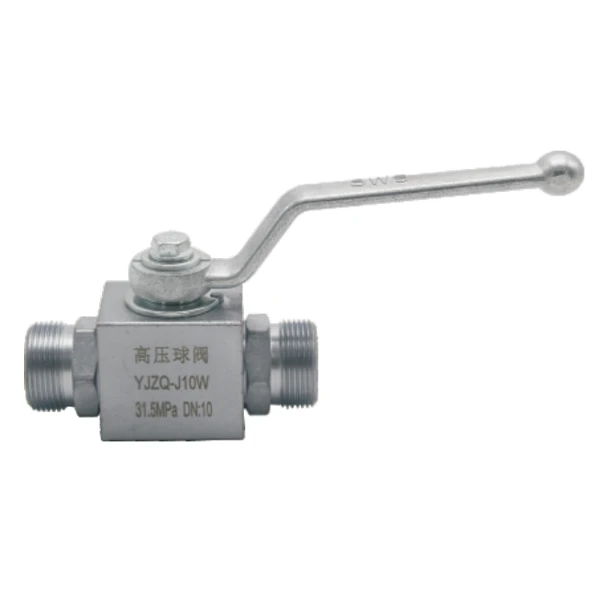
JZQ Manual Hydraulic Ball Valve
Manual hydraulic ball valve for quick shut-off and line isolation.
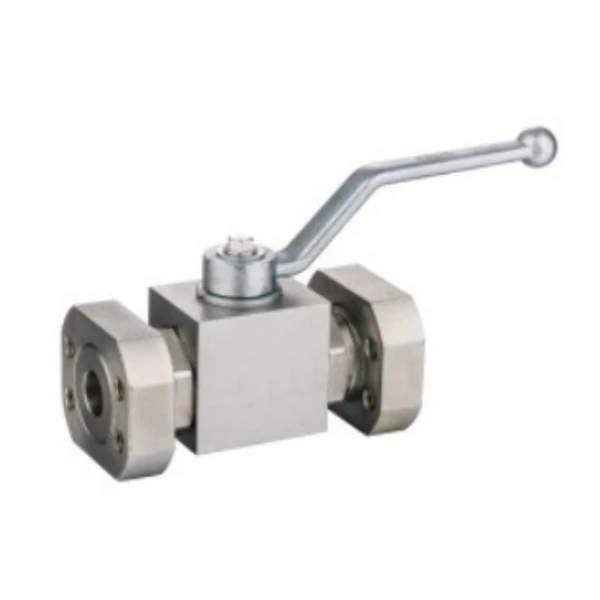
KHB Hydraulic Block Ball Valve
Compact block-style valve for high pressure hydraulic systems.
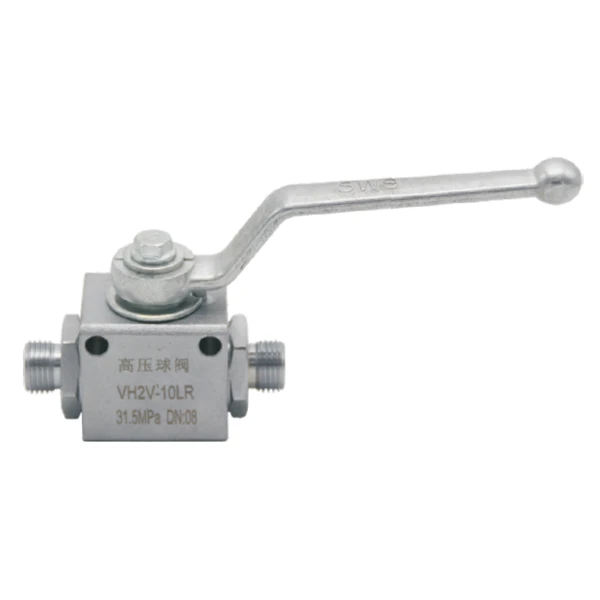
VH2V Two-Way Hydraulic Ball Valve
Two-way flow control for opening and closing hydraulic lines.
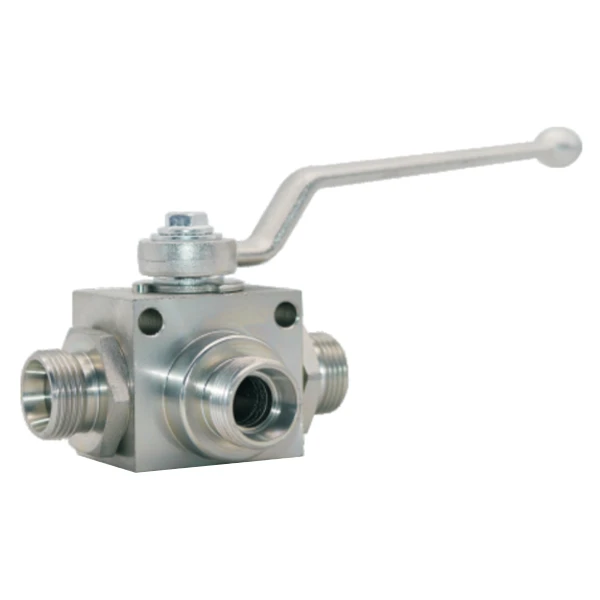
VH3V Three-Way Hydraulic Ball Valve
Three-way design for switching flow direction in hydraulic circuits.
Hydraulic Ball Valve Specifications
Exact specifications depend on the valve series and working conditions. Send us your model, drawing, size, pressure rating, media, and connection standard for accurate selection.
| Item | Common Options | Selection Notes |
|---|---|---|
| Valve Type | Two-way, three-way, block type, flanged type, manual type | Choose according to flow direction, shut-off function, and installation space. |
| Material | Carbon steel, stainless steel, custom material options | Material affects pressure strength, corrosion resistance, service life, and price. |
| Connection | NPT, BSP, SAE, metric thread, flange connection | Connection type should match hoses, pipes, adapters, or manifold blocks. |
| Pressure Rating | Medium pressure and high pressure hydraulic systems | Always confirm working pressure, peak pressure, and safety margin. |
| Seal Type | Standard and application-specific sealing options | Seal choice depends on media, temperature, leakage requirements, and environment. |
| Customization | Port design, handle style, surface treatment, thread standard, special size | Suitable for OEM projects, equipment manufacturers, and special hydraulic systems. |
For a quick quote, provide valve size, pressure rating, material, connection type, quantity, and application.
How to Choose a Hydraulic Ball Valve
Choosing the right hydraulic ball valve helps improve system safety, sealing reliability, and long-term performance. Before placing an order, confirm the following details.
- Working pressure and peak pressure
- Valve size and required flow capacity
- Two-way or three-way flow path
- Thread or flange connection standard
- Carbon steel, stainless steel, or special material
- Hydraulic oil, media type, temperature, and environment
Make sure the valve can handle both normal working pressure and pressure spikes in your hydraulic system.
Check whether your system requires NPT, BSP, SAE, metric thread, or flange connection.
Use two-way valves for simple shut-off and three-way valves for flow switching or direction control.
Send drawings, samples, or technical requirements when standard models do not fully match your system.
Industries We Serve
Chenyang hydraulic ball valves are trusted by engineers and OEM manufacturers across a wide range of high-pressure fluid control applications worldwide.
Hydraulic ball valves used in excavators, loaders, cranes, and drilling rigs require extreme pressure durability and resistance to vibration and contamination. Our valves are built to withstand the demands of mobile hydraulic circuits operating under variable loads.
Precision hydraulic circuits in CNC machining centers, presses, and industrial automation systems demand stable flow control and low-leakage performance. Chenyang ball valves provide consistent shut-off performance for clamping, coolant, and lubrication circuits.
In oil and gas applications, hydraulic ball valves serve as isolation and shut-off devices in high-pressure fluid transfer systems. Our carbon steel and stainless steel variants are suited for both upstream and downstream environments, including wellhead control and pipeline monitoring.
Chemical processing plants require corrosion-resistant valves that provide reliable sealing when handling aggressive fluids. Our stainless steel 304/316 hydraulic ball valves offer excellent chemical resistance for reactor isolation, tank transfer, and pipeline control applications.
Hydraulic power units require reliable shut-off, flow diversion, and pressure isolation valves. Our 2-way and 3-way ball valves are widely used in HPU manifold assemblies for industrial presses, injection molding machines, and test bench systems.
Marine hydraulic systems on vessels, offshore platforms, and port equipment demand valves that withstand salt-spray environments and continuous duty cycles. Our stainless steel and epoxy-coated ball valves provide long service life in demanding offshore conditions.
What is a hydraulic ball valve?
A hydraulic ball valve is a quarter-turn shut-off valve that uses a hollow, perforated, and pivoting ball to control the flow of hydraulic fluid within a pressurized system. When the ball’s bore is aligned with the flow path, the valve is fully open; rotating the ball 90 degrees blocks the flow completely, providing a fast and reliable shut-off.
Unlike standard plumbing ball valves, high-pressure hydraulic ball valves are engineered to withstand extreme working pressures — typically from 315 bar (4,570 PSI) to 500 bar (7,250 PSI) — using reinforced body construction, precision-machined seats, and high-performance sealing materials such as PTFE or NBR.
Hydraulic ball valves are used across a wide range of industrial applications including construction machinery, hydraulic power units, oil and gas pipelines, machine tools, and marine systems. They are preferred for their low pressure drop, compact design, full-bore flow path, and ease of operation — even under high-pressure and high-cycle conditions.
At Chenyang Hydraulic, all ball valves are manufactured with precision CNC-machined bodies, tested to rated pressure, and inspected for dimensional accuracy and thread quality before shipment.
FAQs
What is the difference between a hydraulic ball valve and a normal ball valve?
A hydraulic ball valve is usually built for higher pressure, stronger sealing, and hydraulic oil systems. A normal plumbing ball valve may not be suitable for high pressure hydraulic applications.
What materials are the ball valves made of?
Standard hydraulic ball valves are manufactured from high-strength carbon steel (20# or 35# steel bar stock or forgings). For corrosive environments, food-grade, or chemical applications, stainless steel 304 and 316 are available. Sealing materials include PTFE seats (standard) and NBR or FKM O-rings. Surface treatments (zinc phosphate, nickel plating, hard chrome) are available on request.
Can you make custom hydraulic ball valves?
Yes. We can support custom hydraulic ball valves based on drawings, samples, pressure ratings, connection standards, materials, and special installation requirements.
Which hydraulic ball valve connection types are available?
Common options include NPT, BSP, SAE, metric thread, and flange connections. The correct option depends on your pipe, hose, adapter, or manifold design.
How can I get an accurate hydraulic ball valve price?
Please send valve size, pressure rating, material, connection type, quantity, and application. These details help us provide a more accurate quotation.
Contact Us
Talk to our engineering team for product selection, technical support, and customized hydraulic valve solutions.
Ready to Source Hydraulic Ball Valves?
Send us your drawing, model number, pressure rating, material, connection standard, quantity, or application details. Chenyang Hydraulic can help you choose or customize the right hydraulic ball valve for your project.