
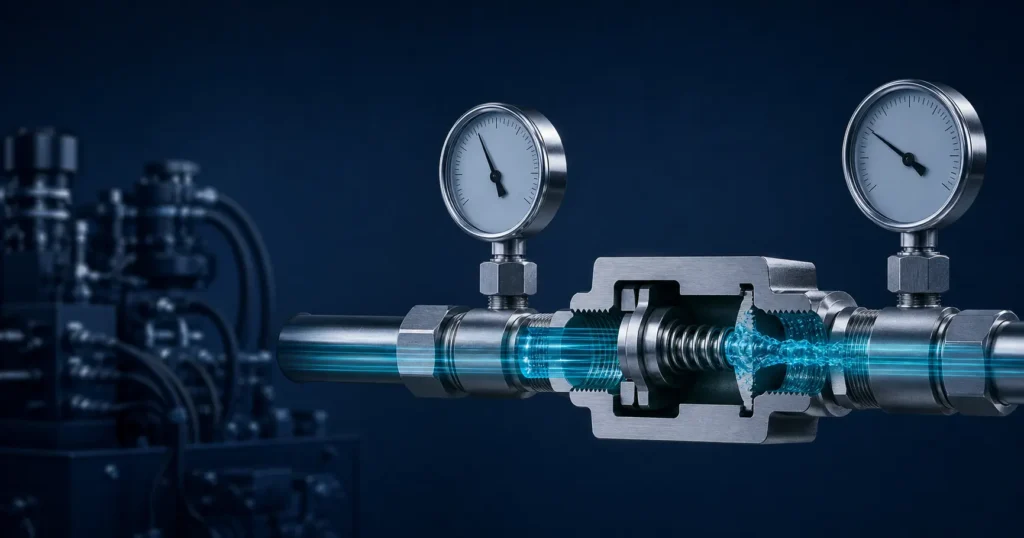
Yes. A check valve creates some resistance because fluid must pass through an internal opening and move a ball, poppet, or disc away from its seat. In a spring-loaded check valve, the fluid must also overcome spring force. This resistance causes pressure drop and may reduce the available flow if the valve is undersized, partly open, contaminated, or incorrectly selected.
Key Takeaways
- Every check valve creates some pressure drop, even when it is working correctly.
- Pressure drop is not exactly the same as flow rate, but excessive pressure loss can limit flow and reduce downstream performance.
- Cracking pressure is only the pressure needed to begin opening the valve; it is not the total pressure drop at full flow.
- Valve size, internal passage, closing element, spring force, flow rate, oil viscosity, temperature, and contamination all affect restriction.
- An undersized check valve can create heat, noise, slow cylinder movement, pump load, and unstable operation.
- Use manufacturer flow or pressure-drop data whenever possible instead of selecting by port size alone.
Why Does a Check Valve Reduce Flow?
Fluid flowing through a straight pipe loses some energy because of friction. A check valve adds more resistance because the flow path changes direction or becomes narrower, and because the fluid must move an internal closing element.
This energy loss appears as a pressure difference between the inlet and outlet. Engineers usually describe it as pressure drop or head loss. If the pump and system cannot supply enough additional pressure, the available flow may decrease.
Direct Answer: A check valve does not intentionally regulate flow, but it always introduces some resistance. The goal is to keep that resistance low enough for the required system performance.
Pressure Drop vs Flow Reduction
Pressure drop and flow reduction are related, but they are not identical.
Pressure drop is the loss of pressure as fluid passes through the valve. Flow rate is the volume of fluid passing through per unit of time. The final flow rate depends on the pump, system pressure, actuator load, pipework, fluid, and all restrictions in the circuit.
If a positive-displacement hydraulic pump continues delivering nearly the same flow, an added restriction may first appear as higher upstream pressure, more power consumption, and more heat. If pressure reaches a relief setting, pump limit, or control limit, the usable flow to the actuator may then decrease.
In another system, especially one driven by a centrifugal pump or a pressure-limited source, adding a restrictive check valve may directly move the operating point to a lower flow rate.
What Is Cracking Pressure?
Cracking pressure is the minimum inlet-to-outlet pressure difference required to begin opening a check valve. It is especially important for spring-loaded designs.
At cracking pressure, the valve has only started to open. The flow area may still be small. As the flow increases, additional pressure difference is normally required to move the closing element farther and pass more fluid.
Important: Do not use cracking pressure as if it were the pressure drop at rated flow. Ask for the full pressure-drop curve or a pressure-drop value at your required flow rate.
What Determines Check Valve Pressure Drop?
Valve Size and Internal Flow Area
A valve may have the correct thread size but still have a small internal passage. If the required flow is high compared with the effective opening area, fluid velocity and pressure drop increase.
Valve Design
Ball, poppet, swing, disc, cartridge, and pilot-operated check valves have different flow paths. A guided poppet, spring chamber, ball cage, or sharp internal turn can change the resistance.
Spring Force
A stronger spring requires more pressure to begin and continue opening the valve. A high cracking pressure may be necessary for a specific circuit function, but it should not be used without considering the effect on downstream pressure and efficiency.
Flow Rate
Pressure drop generally rises as flow increases. A valve that performs well at a low flow may become restrictive when the same port size is used at a much higher flow.
Fluid Viscosity and Temperature
Cold hydraulic oil is more viscous and may produce greater pressure loss. As the oil warms, viscosity falls and flow resistance may decrease. Selection should consider cold start as well as normal operating temperature.
Opening Position
A check valve that is only partly open presents a smaller flow area. Insufficient pressure difference, an overly strong spring, unstable flow, or mechanical sticking may prevent full opening.
Contamination and Wear
Particles, varnish, corrosion, or damaged internal surfaces can obstruct the passage, increase friction, stop the element from moving freely, or prevent proper sealing.
Installation and Piping
Incorrect flow direction, unsuitable mounting orientation, adapters, small hoses, sharp bends, and undersized nearby fittings may add restriction that is mistakenly blamed on the check valve.
How Different Check Valve Types Affect Flow
| Valve Type | Typical Flow Characteristic | What to Check |
| Spring-loaded inline | Compact but spring force and guided element add resistance | Cracking pressure and pressure-drop curve |
| Ball check | Ball and seat narrow the passage until the ball moves fully away | Ball travel, guide, spring, orientation |
| Poppet check | Guided poppet can seal reliably but effective area matters | Poppet stroke, spring, seat diameter |
| Swing check | Can provide a relatively open path when fully open | Orientation, minimum velocity, closing behavior |
| Cartridge check | Compact manifold flow path may contain turns or small cavities | Cavity geometry and manifold passage |
| Pilot-operated check | Additional pilot and internal mechanisms may affect the flow path | Pilot ratio, drain arrangement, rated flow |
These are general tendencies, not guaranteed rankings. Two valves of the same type and port size may have very different pressure-drop performance because their internal geometry is different.
Signs That a Check Valve Is Restricting Flow
- A hydraulic cylinder or motor moves more slowly than expected.
- Pressure before the valve is much higher than pressure after the valve.
- Oil temperature rises during operation.
- The pump becomes noisy or operates close to the relief pressure.
- The valve chatters, whistles, or repeatedly opens and closes.
- Performance becomes worse during a cold start.
- The actuator speed changes after the check valve is removed or bypassed during a controlled diagnostic test.
- The problem appeared after replacing the valve with a different model of the same nominal port size.
How to Estimate Whether the Valve Is Suitable
Use a Pressure-Drop Curve
The most useful source is a manufacturer curve showing pressure drop at different flow rates. Confirm the test fluid and viscosity because results can change with fluid properties.
Check Cv or Kv When Available
Cv or Kv is a flow coefficient used to describe valve capacity. A larger coefficient generally indicates less restriction at a given flow, but the correct calculation must use the appropriate units, fluid density, viscosity correction, and valve data.
Measure Differential Pressure
In an existing system, pressure gauges or transducers installed immediately before and after the valve can show the pressure difference under actual operating flow. Follow safe test procedures and use instruments rated for the system pressure.
Check the Entire Flow Path
Do not evaluate the check valve alone. Hose size, pipe length, adapters, elbows, quick couplings, filters, manifolds, throttle valves, and return-line restrictions all contribute to total pressure loss.
How to Reduce Check Valve Flow Restriction
- Select the valve using required flow and pressure-drop data, not only nominal port size.
- Use the lowest suitable cracking pressure for the required circuit function.
- Choose an internal design with adequate effective flow area.
- Increase valve or line size when the existing pressure drop is too high and the circuit permits it.
- Avoid unnecessary adapters, sharp bends, and undersized fittings near the valve.
- Use the correct fluid viscosity range and consider cold-start conditions.
- Maintain filtration and fluid cleanliness to prevent sticking and blockage.
- Install the valve in the marked direction and approved orientation.
- Inspect the spring, ball or poppet, seat, seals, and guide when performance changes.
- Confirm that the pump, relief valve, and actuator requirements match the selected valve.
Can a Check Valve Be Used to Control Flow?
A standard check valve should not be selected as the main adjustable flow-control device. Its purpose is to allow one-way flow and block reverse flow. The opening position changes automatically with pressure and flow, so it does not provide the stable manual adjustment of a throttle or speed control valve.
Some hydraulic components combine a check valve with a throttle. In a one-way flow control valve, the check valve allows relatively free flow in one direction while the throttle restricts flow in the opposite direction. This is different from trying to use a basic check valve as a flow regulator.
Selection Tip: If the goal is cylinder or motor speed adjustment, evaluate a hydraulic throttle valve or speed control valve instead of deliberately undersizing a check valve.
Example: Why Port Size Alone Can Be Misleading
Consider two check valves with the same nominal threaded connection. Valve A has a larger effective seat diameter, longer opening stroke, and a low spring preload. Valve B has a smaller internal passage and a stronger spring.
Although both valves fit the same hose, Valve B may need more pressure to open and may create a larger pressure drop at the required flow. The external size does not reveal the full internal flow capacity.
This is why buyers should request rated flow, pressure-drop data, cracking pressure, and a dimensional drawing rather than selecting only from the thread description.
Common Selection Mistakes
- Treating cracking pressure as the total pressure drop.
- Using port size as the only flow-capacity indicator.
- Ignoring cold-oil viscosity.
- Choosing a high cracking pressure without a circuit reason.
- Failing to include pressure spikes and peak flow.
- Ignoring adapters and other restrictions around the valve.
- Assuming a larger outside body always means a larger internal passage.
- Replacing a valve without comparing the original and new pressure-drop curves.
- Using a check valve for adjustable speed control.
What Data Should You Provide Before Buying?
| Information | Why It Matters |
| Normal and maximum pressure | Confirms pressure rating and available differential pressure |
| Normal and peak flow | Allows pressure drop to be checked at real operating conditions |
| Cracking pressure | Determines when the valve begins to open |
| Fluid and viscosity | Affects flow resistance and material compatibility |
| Temperature range | Helps evaluate cold start, viscosity, and seals |
| Connection and line size | Ensures mechanical fit and avoids local restrictions |
| Circuit function | Shows whether the valve is for pump protection, bypass, makeup, or load holding |
| Installation orientation | Important for gravity-sensitive designs |
| Allowable leakage | Helps select ball, poppet, seat, and seal design |
| Drawing or model reference | Reduces errors when replacing or customizing a valve |
Conclusion
Check valves do reduce available pressure because every valve adds resistance to the flow path. Whether this produces a noticeable reduction in flow depends on the pump, system, load, valve size, internal design, spring force, oil viscosity, temperature, and operating point.
A correctly selected check valve should prevent reverse flow while keeping pressure drop within an acceptable range. To make a reliable selection, compare cracking pressure and pressure-drop data at the required flow, not just the port size.
Chenyang Hydraulic can review your working pressure, peak flow, cracking pressure, connection, fluid, temperature, drawing, or existing model. Clear data helps identify whether a standard check valve is suitable or whether a different size, spring, material, or custom configuration should be evaluated.
Frequently Asked Questions
Do all check valves restrict flow?
Yes. Every check valve introduces some resistance, although the amount can be small when the valve is correctly sized and fully open.
How much pressure does a check valve reduce?
There is no single value. Pressure drop depends on valve design, size, spring force, flow rate, fluid viscosity, temperature, and opening position. Use the manufacturer’s data at the required flow.
Is cracking pressure the same as pressure drop?
No. Cracking pressure is the pressure difference needed to begin opening the valve. Pressure drop at normal or rated flow is usually different and may be higher.
Can an oversized check valve cause problems?
Yes. An oversized valve may not open or move stably at low flow, and some designs may chatter. Selection should match the expected flow range, not simply choose the largest valve.
Why is the pressure drop higher when the oil is cold?
Cold hydraulic oil is usually more viscous. Higher viscosity increases resistance through small passages and around the internal valve element.
Can I remove the spring to improve flow?
Do not modify the valve without engineering approval. Removing or changing the spring alters cracking pressure, closing response, orientation capability, and backflow protection.
Which check valve has the lowest pressure drop?
There is no universal answer based only on type. Compare tested pressure-drop data for the exact valve size, spring, fluid, and flow range.
Should I use a check valve to slow a hydraulic cylinder?
No. Use a suitable throttle, flow control, or speed control valve. A basic check valve is intended for one-way flow protection, not adjustable speed control.