
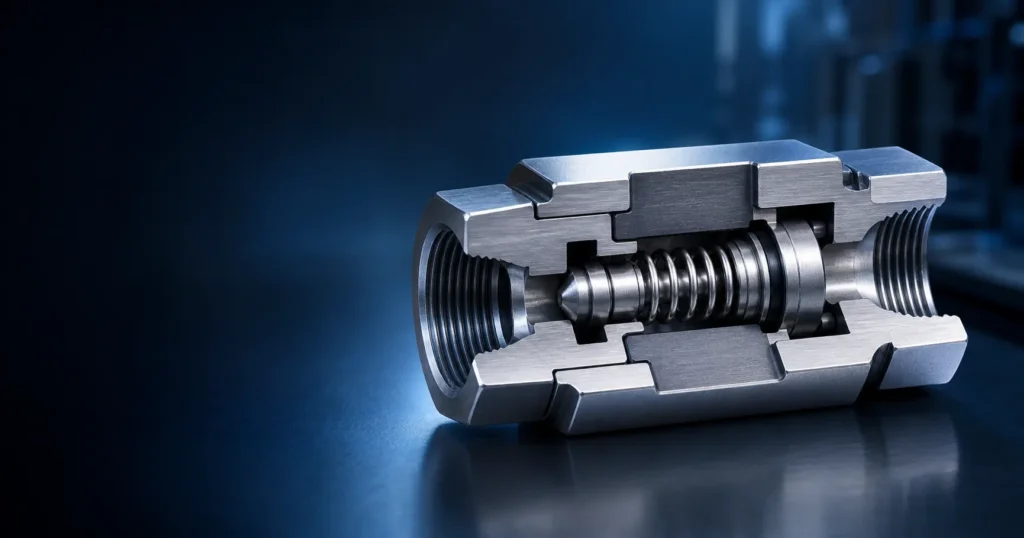
A spring check valve is a self-acting valve that allows fluid to move in one direction and prevents it from flowing backward. A spring holds the internal closing element against the valve seat. When inlet pressure becomes high enough to overcome the spring force, the valve opens. When pressure drops or reverse flow begins, the spring helps the valve close again.
Key Takeaways
- A spring check valve allows forward flow and automatically blocks reverse flow.
- The spring keeps the ball, poppet, or disc against the seat until inlet pressure reaches the cracking pressure.
- Cracking pressure is one of the most important specifications when selecting a spring-loaded check valve.
- A spring-assisted design can close quickly and does not depend only on gravity.
- The spring and internal flow path create resistance, so pressure drop and flow capacity must be checked.
- Pressure rating, connection, material, seal, fluid, temperature, and installation direction must match the hydraulic system.
What Is a Spring Check Valve?
A spring check valve, also called a spring-loaded check valve or spring non-return valve, is a two-port valve designed for one-way flow. It normally remains closed because the spring pushes the closing element against the seat.
The closing element may be a ball, poppet, cone, or guided disc. The exact structure depends on the valve design and application. In hydraulic systems, compact poppet and ball designs are common because they can be installed directly in a line, manifold, or valve block.
Unlike a manual shut-off valve, a spring check valve does not need a handle or actuator. It responds automatically to the pressure difference between the inlet and outlet.
Note: A spring check valve is mainly used to prevent reverse flow. It is not a substitute for a throttle valve or flow control valve when the system needs adjustable speed or precise flow regulation.
How Does a Spring Check Valve Work?
The operating principle is based on the balance between fluid pressure and spring force. The valve changes position automatically as the pressure difference changes.
Forward Flow
During forward flow, fluid enters the inlet side and applies force to the internal valve element. At first, the spring keeps the valve closed. When inlet pressure becomes high enough to overcome the spring preload and downstream pressure, the element moves away from the seat and fluid passes through the valve.
As flow increases, the valve may open farther. The final opening position depends on the spring rate, valve geometry, fluid properties, pressure difference, and flow rate.
Flow Stops
When the pump stops or forward pressure decreases, the spring pushes the closing element back toward the seat. This spring-assisted movement helps the valve close before a large amount of reverse flow develops.
Reverse Pressure
If pressure becomes higher on the outlet side, reverse pressure pushes the valve element more firmly against the seat. The valve then blocks backflow and helps protect pumps, cylinders, accumulators, and other parts of the hydraulic circuit.
What Is Cracking Pressure?
Cracking pressure is the minimum inlet-to-outlet pressure difference required to begin opening the check valve. It does not mean the valve is fully open. Additional pressure may be needed to move the element farther and pass the required flow.
The spring preload has a direct effect on cracking pressure. A stronger or more compressed spring generally requires more inlet pressure before the valve starts to open.
Selection Tip: Do not select a spring check valve by thread size alone. Ask for the cracking pressure and the pressure drop at your required flow rate.
Why Cracking Pressure Matters
- If cracking pressure is too high, the actuator may respond slowly or the pump may need to produce unnecessary pressure.
- If cracking pressure is too low, the valve may open before the circuit reaches the pressure needed for its intended function.
- An incorrect value can affect system efficiency, heat generation, pressure stability, and response time.
- In low-pressure pilot or control lines, even a small difference in cracking pressure may matter.
Main Components of a Spring Check Valve
Valve Body
The body contains the internal parts and provides the connection to the pipeline, hose, manifold, or hydraulic block. Common body materials include carbon steel and stainless steel, depending on pressure, corrosion exposure, fluid, and environment.
Closing Element
The closing element blocks reverse flow. It may be a ball, poppet, cone, or disc. Its shape influences sealing contact, flow area, response, and pressure drop.
Spring
The spring holds the valve in its normally closed position and helps determine the cracking pressure. Spring material and fatigue resistance are important when the valve operates through frequent cycles.
Seat and Seals
The seat forms the sealing surface with the closing element. Some designs use metal-to-metal contact, while others use an elastomer or polymer seal. The sealing arrangement must be compatible with pressure, fluid, temperature, and leakage requirements.
Common Spring Check Valve Designs
| Design | How It Closes | Typical Use | Selection Focus |
| Spring-loaded ball | Spring pushes a ball onto the seat | Compact general one-way circuits | Ball guidance, cracking pressure, leakage |
| Spring-loaded poppet | Spring pushes a guided poppet or cone onto the seat | Higher-pressure hydraulic lines and controlled closing | Seat geometry, flow capacity, sealing requirement |
| Inline spring check | Internal spring element closes inside a line-mounted body | Pump outlets, power units, general pipelines | Thread, pressure rating, installation space |
| Cartridge spring check | Spring-loaded element closes inside a manifold cavity | Compact manifolds and valve blocks | Cavity drawing, dimensions, flow path |
Advantages of Spring Check Valves
- Automatic operation without a handle, motor, or external control signal.
- Spring-assisted closing when forward pressure falls.
- Compact construction for inline and manifold installations.
- Operation is less dependent on gravity than an unassisted swing or gravity ball design.
- Different spring options can provide controlled cracking pressures.
- Useful for pump protection, pressure retention, bypass circuits, and directional control functions.
Limitations to Consider
- The spring creates opening resistance and contributes to pressure drop.
- A valve that is too small may restrict flow, produce heat, create noise, or slow an actuator.
- Spring fatigue, corrosion, contamination, or deposit buildup may affect closing performance.
- A standard spring check valve is not automatically suitable for holding a suspended load.
- Very low differential pressure may be insufficient to open a valve with a high spring preload.
Spring Check Valve vs Swing Check Valve
| Comparison | Spring Check Valve | Swing Check Valve |
| Closing method | Spring returns the element to the seat | Reverse flow and gravity move a hinged disc |
| Installation | Often supports more mounting orientations, subject to design | Usually more sensitive to orientation |
| Closing response | Generally faster because closure is spring-assisted | May close more slowly in some systems |
| Pressure drop | Spring preload adds opening resistance | Can offer a relatively open flow path when fully open |
| Typical size/use | Compact hydraulic and process lines | Common in larger piping and lower-velocity service |
Where Are Spring Check Valves Used?
Hydraulic Power Units
A spring check valve can help stop oil from returning through the pump or into the wrong part of the circuit when the pump stops.
Pump Outlet Protection
At a suitable pump outlet location, the valve may help prevent reverse flow toward the pump. Pressure rating, pulsation, flow capacity, and cracking pressure must be checked.
Bypass and Makeup Circuits
Spring check valves are often used where oil should pass freely in one direction but remain blocked in the other direction, such as bypass paths around another valve.
Mobile and Industrial Equipment
Construction machinery, agricultural equipment, machine tools, presses, and industrial hydraulic systems may use spring-loaded check valves for general backflow protection and circuit separation.
Manifolds and Compact Valve Blocks
Cartridge designs can be installed inside a manifold cavity to reduce external piping and save installation space.
How to Select a Spring Check Valve
1. Confirm the System Function
Decide whether the valve only needs to stop reverse flow or whether it also needs to support a specific opening pressure, bypass function, pump outlet, or pressure-retention function.
2. Check Working and Peak Pressure
The valve pressure rating must be suitable for normal working pressure and expected pressure peaks. Also check the ratings of fittings, hoses, pipes, and manifolds.
3. Confirm Flow and Pressure Drop
Provide the required flow rate and ask for pressure-drop information. Thread size alone does not show the internal flow capacity.
4. Choose the Cracking Pressure
Select a cracking pressure that matches the circuit function. If you are unsure, provide a hydraulic schematic and operating conditions to the manufacturer.
5. Match Connection and Installation
Confirm BSP, NPT, metric, SAE, cartridge cavity, or other connection details. Also confirm male or female ports, sealing method, flow direction, available space, and mounting orientation.
6. Match Materials and Seals
Provide the hydraulic fluid, temperature range, corrosion exposure, and leakage requirements. Material compatibility is especially important with water-glycol fluids, synthetic fluids, high temperature, or corrosive environments.
Common Selection and Installation Mistakes
- Ordering by outside appearance or thread size without checking the internal design.
- Ignoring cracking pressure and pressure drop.
- Installing the valve against the marked flow direction.
- Using a standard check valve where a pilot-operated load-holding valve is required.
- Mixing BSP, NPT, and metric thread standards.
- Selecting seals without confirming fluid and temperature compatibility.
- Using a valve with insufficient pressure rating for pressure spikes.
- Allowing contamination to damage the spring, seat, or closing element.
What Information Should You Send to the Manufacturer?
- Normal working pressure and maximum pressure
- Required flow rate
- Required cracking pressure, if known
- Hydraulic fluid and operating temperature
- Connection standard and port size
- Flow direction and mounting orientation
- Valve material and seal requirements
- Application equipment and circuit function
- Drawing, hydraulic schematic, sample, or existing model number
- Required quantity and OEM requirements
Conclusion
A spring check valve is a simple but important one-way valve. It uses spring force to keep the valve closed until inlet pressure reaches the cracking pressure. When forward pressure falls or flow reverses, the spring helps return the valve element to the seat.
For reliable operation, check more than the connection size. Working pressure, peak pressure, flow rate, pressure drop, cracking pressure, fluid, temperature, materials, seals, and installation direction all affect performance.
Chenyang Hydraulic can evaluate hydraulic check valve requirements using your system data, drawing, sample, or existing model reference. Clear operating information helps identify a suitable standard configuration or determine whether a custom solution is needed.
Frequently Asked Questions
Is a spring check valve normally open or normally closed?
Most spring check valves are normally closed. The spring holds the closing element against the seat until forward pressure exceeds the cracking pressure.
Can a spring check valve be installed vertically?
Many spring-assisted designs can operate vertically or horizontally because the spring provides the closing force. However, installation orientation must still be confirmed for the specific valve design.
Does a spring check valve reduce flow?
Yes. The spring preload and internal passage create resistance and pressure drop. The amount depends on valve size, geometry, flow rate, fluid viscosity, and how far the valve opens.
What happens if cracking pressure is too high?
The circuit may need extra pressure to open the valve. This can slow response, reduce available pressure downstream, increase heat, or prevent sufficient flow in a low-pressure circuit.
Can a spring check valve hold a hydraulic cylinder load?
A standard spring check valve may block reverse flow, but it is not automatically a safe load-holding valve. Systems that must hold a suspended load often require a pilot-operated check valve, counterbalance valve, or another purpose-designed solution.
What is the difference between a spring check valve and a ball check valve?
Spring check describes how the valve is held closed, while ball check describes the shape of the closing element. A ball check valve may be spring-loaded or gravity-assisted.
How do I know the correct flow direction?
Check the arrow or flow marking on the valve body and compare it with the hydraulic schematic before installation.