Hydraulic Speed Control Valves
Control the movement speed of hydraulic cylinders and motors with STU one-way or STB bidirectional throttle valves. Chenyang supplies compact in-line designs for hydraulic oil systems with pressures up to 400 bar and flow rates up to 150 L/min.
Simple, Adjustable Control of Hydraulic Movement
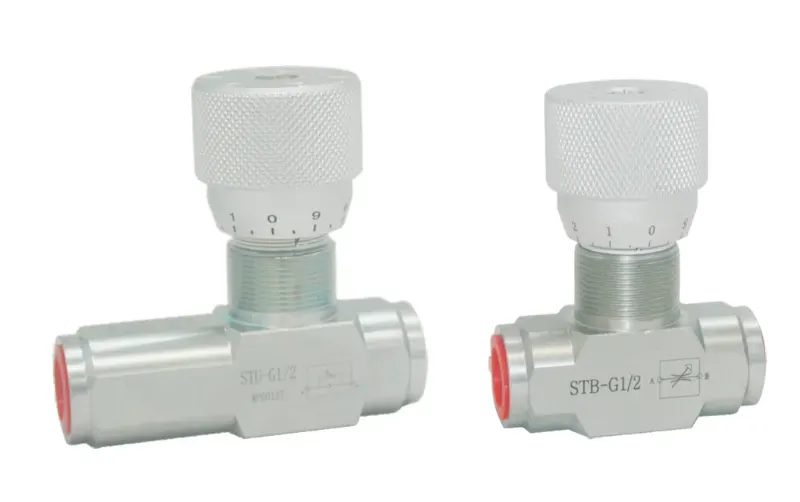
A hydraulic speed control valve regulates the amount of oil flowing to or from a hydraulic cylinder or motor. Reducing the opening decreases flow and slows the actuator; increasing it allows more flow and raises actuator speed.
Chenyang’s STU and STB series are manually adjustable, non-pressure-compensated throttle valves. Choose STU when one direction requires controlled flow with free reverse flow. Choose STB when both directions must pass through an adjustable restriction.
Two Flow Paths for Two Control Needs
The internal flow path—not the outside appearance—determines whether the reverse direction is free or throttled.
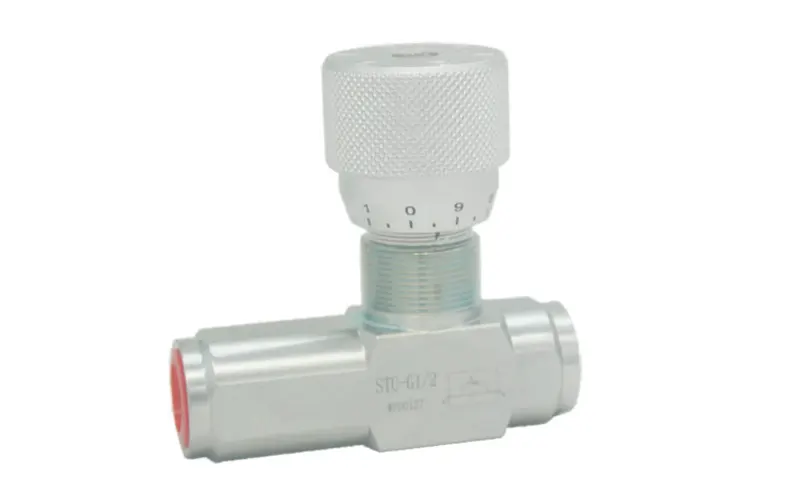
Controlled Flow + Free Reverse Flow
The STU combines an adjustable throttle passage with an integrated check valve. Oil is restricted in the controlled direction and bypasses the restriction in reverse.
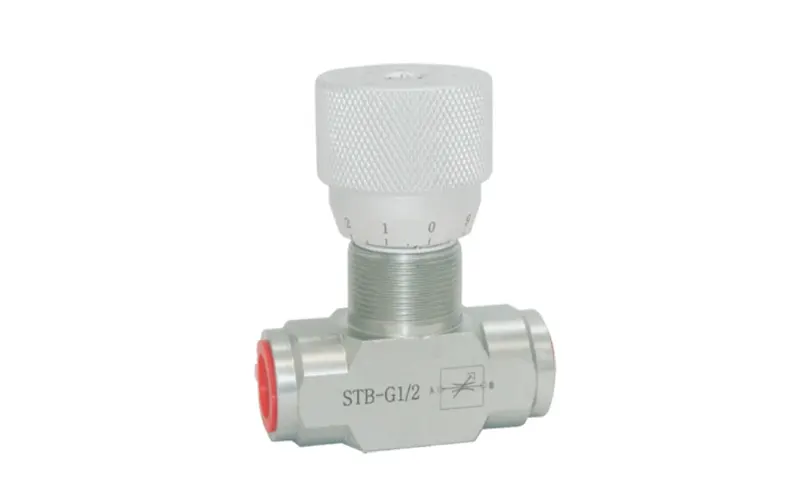
Adjustable Restriction in Both Directions
The STB regulates oil passing through the valve in both directions. It does not provide the dedicated free-flow reverse bypass used in the STU design.
Built for Practical In-Line Flow Adjustment
The range supports common hydraulic connections and working flows without claiming load-independent or electronically controlled performance.
G1/4 through G3/4 models are published at 400 bar; G1 models are published at 320 bar.
Maximum published flow ranges from 12 to 150 L/min across the standard connection sizes.
Turn the adjustment mechanism to increase or reduce the internal flow passage.
Secure the selected setting after commissioning where unintended movement must be reduced.
Choose the thread standard and port size to match the hydraulic line and regional specification.
Send a drawing, sample or system data for replacement and customer-specific requirements.
Where Adjustable Speed Control Adds Value
Circuit design determines whether meter-in, meter-out or bidirectional restriction is appropriate. Overrunning and vertical loads require special attention.
Adjust extension or retraction speed using the correct valve orientation.
Provide basic rotational speed adjustment where load variation is acceptable.
Control flow supplied to selected actuator branches.
Adjust feeding, positioning, clamping and auxiliary movement.
Regulate auxiliary hydraulic functions after pressure and flow review.
Control attachments, lifting mechanisms and implement movement.
Set actuator movement under relatively stable load conditions.
Integrate compact in-line adjustment into an OEM hydraulic circuit.
FAQs
What does a hydraulic speed control valve do?
It regulates hydraulic oil flow to control the movement speed of a cylinder or hydraulic motor.
What is the difference between STU and STB?
STU controls flow in one direction and provides free flow in the opposite direction through an integrated check valve. STB restricts and adjusts flow in both directions.
Which valve should I use for different cylinder extension and retraction speeds?
STU is generally more suitable when one direction requires controlled flow and the opposite direction requires free flow. Two STU valves may be required when extension and retraction speeds need separate adjustment.
Is STB a two-way hydraulic flow control valve?
STB is a bidirectional throttle valve because it restricts hydraulic flow in both directions. It is not a pressure-compensated flow control valve.
Are STU and STB pressure-compensated?
No. Both are non-pressure-compensated adjustable throttle valves.
Will actuator speed remain constant when the load changes?
Not necessarily. Changes in load, pressure difference, oil viscosity and temperature can change the flow rate and actuator speed.
What is the maximum pressure?
STU and STB models from G1/4 through G3/4 have published maximum pressure ratings of 400 bar. The G1 models have published maximum pressure ratings of 320 bar.
What is the maximum flow?
The largest current STU and STB models have published maximum flow ratings of 150 L/min.
Are NPT connections available?
Yes. G and NPT connection configurations are available. Confirm the exact thread and dimensions before ordering.
Can the valves control hydraulic motor speed?
Yes, they can provide basic motor speed adjustment. STU is suitable for one-direction controlled flow, while STB can restrict flow in both directions. Speed can still change when the motor load changes.
Can Chenyang manufacture a custom valve?
Custom requirements can be evaluated using a drawing, sample or complete application data. Provide the pressure, flow, medium, thread, dimensions and required quantity.
Contact Us
Talk to our engineering team for product selection, technical support, and customized hydraulic valve solutions.
Request a Hydraulic Speed Control Valve Quote
Send us your hydraulic system information so we can help you compare STU and STB models.