
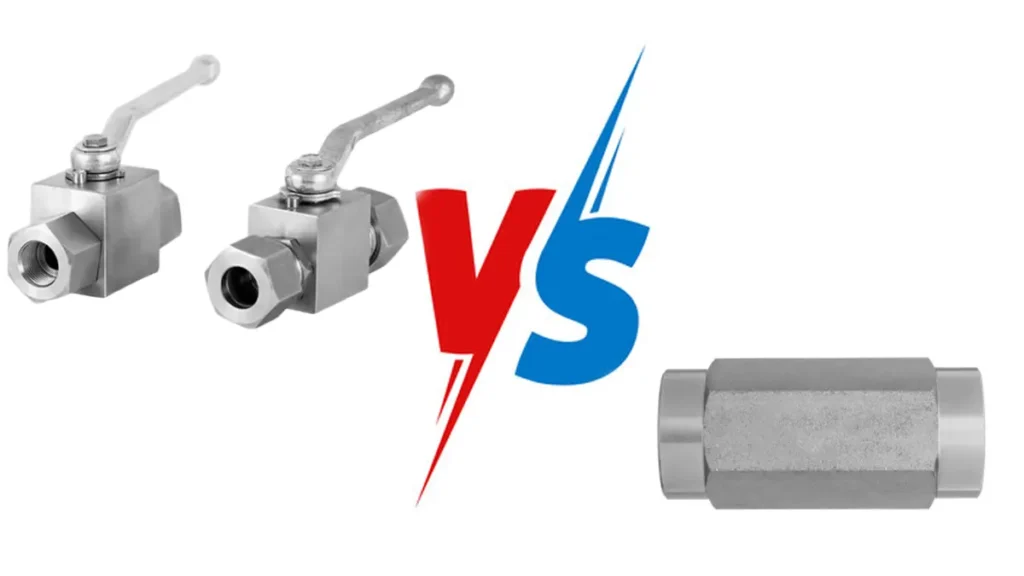
If you work with hydraulic systems, you might think a ball valve and a check valve do the same job. They both stop flow. They both fit in a pipeline. But they work in very different ways. If you use the wrong one, your system can break down. You could damage your pump, lose pressure, or cause a safety hazard. Look at this table to see what each valve does:
| Valve Type | Primary Function | How It Operates | Common Applications |
|---|---|---|---|
| Ball Valve | Opens or closes flow manually | Operator turns handle 90° | Isolation, shut-off, maintenance |
| Check Valve | Prevents backflow automatically | Opens and closes with fluid pressure | Pump protection, one-way circuits, holding loads |
Picking the right valve keeps your system safe and working well. This guide explains how each valve works, what makes them different, and how to choose the right one for your job.
Key Takeaways
- A ball valve requires manual operation. A check valve works automatically without any operator input.
- A check valve only allows flow in one direction. A ball valve can stop or allow flow but does not control direction automatically.
- Ball valves are used for isolation and shut-off. Check valves protect against backflow and hold pressure.
- Never use a ball valve as a check valve. It cannot prevent backflow on its own.
- Check valves have a cracking pressure. Make sure it matches your system’s operating pressure before you install one.
- Both valves are often used together in the same hydraulic circuit for different functions.
- Always check the flow direction arrow on a check valve before installation. Installing it backwards stops all flow.
- For custom hydraulic ball valves, Chenyang Hydraulic offers solutions for many applications and pressure ratings.
What Is a Hydraulic Ball Valve?
A hydraulic ball valve is one of the most common valves in fluid power systems. It uses a round ball with a hole through the center to control flow. When the hole lines up with the pipe, fluid flows through. When you turn the handle 90 degrees, the solid part of the ball blocks the flow. You get a fast, reliable shut-off with just one quarter turn.
Ball valves are designed for on/off control. They do not adjust flow. They either open the path completely or close it completely. This makes them very reliable and long-lasting. The seats inside press tightly against the ball, giving you a seal that rarely leaks.
How a Ball Valve Works
The ball sits inside the valve body between two soft seats. When you turn the handle, the ball rotates. If the hole in the ball lines up with the inlet and outlet ports, fluid moves freely. If the solid side of the ball faces the port, flow stops completely. The handle shows you the position at a glance. When the handle is parallel to the pipe, the valve is open. When it is perpendicular, the valve is closed.
You can operate a ball valve by hand, by pneumatic actuator, or by electric actuator. In automated systems, an actuator opens and closes the valve based on a signal from a controller. This makes ball valves useful in remote or automated hydraulic circuits.
Tip: You can always tell if a ball valve is open or closed by looking at the handle position. Parallel to the pipe means open. Perpendicular means closed. This makes them very easy to check at a glance.
Types of Ball Valves
Ball valves come in several designs. Each one fits different applications. Here is a table to show the main types:
| Type | How It Works | Best For |
|---|---|---|
| 2-Way Ball Valve | One inlet, one outlet; opens or closes flow | Simple on/off isolation in hydraulic lines |
| 3-Way Ball Valve | Three ports; directs flow between two paths | Diverting or mixing flow in two circuits |
| Floating Ball Valve | Ball floats between two seats; pressure pushes it into the seat to seal | Low to medium pressure systems |
| Trunnion-Mounted Ball Valve | Ball is fixed at top and bottom; seats move toward the ball to seal | High-pressure, large-bore systems |
What Ball Valves Are Used For
- Isolating a section of the hydraulic circuit for maintenance or repair
- Emergency shut-off when a system needs to be stopped quickly
- Draining or venting a hydraulic line during servicing
- Directing flow between two circuits in a 3-way configuration
- Blocking flow to a cylinder or motor when the machine is stopped
What Is a Hydraulic Check Valve?
A hydraulic check valve is a one-way valve. It allows fluid to flow in one direction only. When fluid tries to flow backward, the check valve closes automatically. You do not need to do anything. The valve responds to the pressure of the fluid itself. This makes check valves essential for protecting pumps, holding loads, and maintaining pressure in circuits.
Check valves are passive devices. They have no handle, no actuator, and no external control. They open when the inlet pressure is high enough to overcome the spring force inside. They close when the pressure drops or when fluid tries to reverse direction.
How a Check Valve Works
Inside a check valve, there is a poppet, ball, or disc held against a seat by a spring. When fluid pressure at the inlet rises above the cracking pressure, it pushes the poppet off the seat and flow passes through. When the inlet pressure drops or the downstream pressure becomes higher than the inlet pressure, the spring pushes the poppet back onto the seat. This stops the flow instantly and prevents any reversal.
The cracking pressure is the minimum inlet pressure needed to open the valve. This is an important specification. If your system pressure is lower than the cracking pressure, the check valve will never open and no fluid will pass through. Always check this number before you install a check valve.
Tip: Check valves are also called non-return valves or one-way valves. All three names mean the same thing: fluid can only go in one direction.
Types of Check Valves
| Type | How It Works | Best For |
|---|---|---|
| Poppet Check Valve | A spring-loaded poppet lifts off the seat to allow flow | High-pressure hydraulic systems, fast response |
| Ball Check Valve | A ball lifts off a seat to allow flow | General purpose, clean fluid applications |
| Swing Check Valve | A disc swings open on a hinge | Large diameter, low-pressure lines |
| Pilot-Operated Check Valve | Normally closed; a pilot signal opens it to allow reverse flow | Holding cylinder loads, locking circuits |
What Check Valves Are Used For
- Protecting hydraulic pumps from reverse flow when the pump stops or power is lost
- Preventing a vertical hydraulic cylinder from drifting down under its own load
- Maintaining system pressure in a circuit after the pump stops
- Stopping cross-flow between two parallel pump circuits
- Locking a load in position until a pilot signal releases it (pilot-operated check valve)
Ball Valve vs Check Valve: Key Differences
Now let’s compare these two valves directly. Understanding the differences helps you choose the right one and avoid costly mistakes.
Design and Operation Comparison
| Feature | Ball Valve | Check Valve |
|---|---|---|
| Operation Method | Manual, pneumatic, or electric | Automatic, driven by fluid pressure |
| Flow Direction Control | Both directions can be blocked | One direction only; auto-closes on reverse |
| Moving Parts | Ball and stem | Poppet, ball, or disc and spring |
| External Control Needed | Yes | No |
| Can Be Locked Open or Closed | Yes | No |
| Position Indicator | Yes (handle position) | No |
| Structure Complexity | Simple | Simple to moderate |
| Activation | Operator or actuator | Fluid pressure difference |
Function and Application Comparison
| Feature | Ball Valve | Check Valve |
|---|---|---|
| Primary Function | Isolate or shut off flow | Prevent backflow automatically |
| Typical Applications | Maintenance isolation, emergency shut-off | Pump protection, load holding, pressure retention |
| Installation Position | Any orientation | Must follow flow direction arrow |
| Response to Reverse Flow | No automatic response | Closes immediately |
| Maintenance | Replace seats and seals when worn | Replace spring and poppet when worn |
| Cost | Low to medium | Low |
| Pressure Drop When Open | Very low (full bore) | Low to moderate (spring resistance) |
| Suitable for Throttling | No | No |
Can a Ball Valve Replace a Check Valve?
No. A ball valve cannot replace a check valve. Here is why. A ball valve only stops flow when an operator or actuator closes it. If the power fails, if the operator forgets, or if the system experiences a sudden pressure reversal, the ball valve stays in its last position. It does not respond to reverse flow on its own. Your pump will spin backward, your cylinder will drift, and your system will lose pressure.
Important: Never rely on a closed ball valve to protect your pump from reverse flow. If power fails and the ball valve is open, nothing stops the fluid from flowing backward through the pump. This can destroy the pump in seconds. Always install a check valve at the pump outlet for backflow protection.
Can a Check Valve Replace a Ball Valve?
No. A check valve cannot replace a ball valve either. A check valve has no way to stop forward flow on purpose. You cannot close it manually to isolate a section of pipe for maintenance. You cannot use it as an emergency shut-off. It will always open when the inlet pressure is high enough. If you need to stop flow for any reason other than backflow prevention, you need a ball valve.
How They Work Together in a Hydraulic Circuit
Ball valves and check valves are not competitors. They solve different problems. In most professional hydraulic systems, you will find both types of valves working together in the same circuit. Each one does a job the other cannot do.
Here are some common circuit applications where both valves are used together:
| Circuit Application | Ball Valve Role | Check Valve Role |
|---|---|---|
| Pump outlet circuit | Isolates the pump for maintenance or replacement | Prevents reverse flow through the pump when it stops |
| Vertical cylinder circuit | Manually shuts off flow to the cylinder | Holds the load in position; prevents cylinder from drifting down |
| Parallel pump system | Each pump line has a ball valve for individual shut-off | Prevents high-pressure pump from pushing flow backward through low-pressure pump |
| Hydraulic accumulator circuit | Isolates accumulator for safe maintenance | Keeps accumulator charged; stops backflow to the pump |
| Return line circuit | Shuts off return line for servicing | Prevents backflow from reservoir into the circuit |
Tip: Installing a ball valve and a check valve together at each pump outlet is standard practice in professional hydraulic systems. The ball valve lets you isolate the pump for service. The check valve protects the pump from reverse flow every time it stops. You need both.
Key Selection Factors
When to Choose a Ball Valve
You should choose a ball valve when you need manual control over the flow in your system. Here are the situations where a ball valve is the right choice:
- You need to isolate a section of the circuit for maintenance, repair, or inspection
- You need a fast emergency shut-off that can be operated by hand or by an actuator
- You want to direct flow between two different circuits using a 3-way valve
- You need to drain or vent a hydraulic line safely before working on it
- You want a valve you can lock in the open or closed position for safety
| Your Condition | Ball Valve is the Right Choice Because |
|---|---|
| Routine maintenance shut-off needed | Ball valve can be locked closed to isolate the circuit |
| Emergency stop required | Quarter-turn operation stops flow in under one second |
| Automated system control | Works with pneumatic or electric actuators |
| Bidirectional flow blocking needed | Stops flow from either direction when closed |
| Visual confirmation of valve status needed | Handle position clearly shows open or closed |
When to Choose a Check Valve
You should choose a check valve when you need automatic protection against reverse flow without any operator involvement. Here are the situations where a check valve is the right choice:
- You need to protect your hydraulic pump from spinning backward when it stops
- You need to hold a vertical cylinder in position when the machine is idle
- You need to keep pressure in an accumulator or a loaded circuit when the pump is off
- You have two or more pumps running in parallel and need to prevent cross-flow
- You need to lock a load in place until a deliberate signal releases it (use a pilot-operated check valve)
| Your Condition | Check Valve is the Right Choice Because |
|---|---|
| Pump needs backflow protection | Closes automatically the moment pump pressure drops |
| Vertical cylinder must hold position | Blocks reverse flow from cylinder to tank without operator input |
| System must stay pressurized at rest | Holds pressure in circuit after pump shuts off |
| Parallel pumps need isolation | Stops high-pressure pump from back-feeding lower-pressure pump |
| Load must stay locked until released | Pilot-operated check valve holds load until pilot signal opens it |
Quick Decision Guide
| Your Need | Recommended Valve | Reason |
|---|---|---|
| Manually stop flow at any time | Ball Valve | Requires deliberate operation; can be locked |
| Prevent backflow automatically | Check Valve | Responds to pressure difference without operator |
| Isolate system for maintenance | Ball Valve | Locks closed to keep circuit safe during service |
| Protect pump from reverse flow | Check Valve | Auto-closes when pump stops; no operator needed |
| Direct flow between two paths | 3-Way Ball Valve | Rotates to switch flow between port B and port C |
| Hold a vertical load at rest | Pilot-Operated Check Valve | Locks load in place; releases only on pilot signal |
| Both isolation and backflow protection | Ball Valve + Check Valve | Each handles a different function in the same circuit |
Common Mistakes When Selecting Ball Valves and Check Valves
Using a Ball Valve to Prevent Backflow
This is the most dangerous mistake. Some engineers close a ball valve on the pump outlet and assume it will prevent backflow. It does not. If the operator forgets to close it, or if the actuator fails, the valve stays open. When the pump stops, fluid flows backward through the open ball valve and through the pump. The pump spins in reverse. This can destroy the pump shaft seal, the drive coupling, or the pump itself in a very short time.
Note: A ball valve has no awareness of flow direction. It only does what you tell it. A check valve always responds to the fluid. For backflow protection, always install a check valve. A ball valve is not a substitute.
Installing a Check Valve Backwards
Every check valve has a flow direction arrow on the body. If you install it backwards, it will block all forward flow and allow reverse flow. Your system will not work at all. This is a very common mistake during assembly, especially when working in tight spaces where it is hard to read the markings. Always check the arrow before you tighten the fittings.
Ignoring Cracking Pressure
Every check valve has a cracking pressure specification. This is the minimum pressure required to push the poppet off the seat and open the valve. If your system operates at a pressure below the cracking pressure, the check valve will never open. No fluid will pass. Your actuator will not move. Always compare the cracking pressure of the check valve to the minimum operating pressure of your system. Make sure the cracking pressure is lower than your system’s minimum working pressure.
Tip: Standard hydraulic check valves typically have a cracking pressure between 0.5 bar and 3.5 bar. If your system runs at very low pressure, specify a low-cracking-pressure check valve when you order.
Using a Ball Valve for Throttling
A ball valve is not a flow control valve. If you partially open a ball valve to reduce flow, the fluid jets through the small gap at high velocity. This erodes the soft seats and the ball surface very quickly. After a short time, the valve leaks even when fully closed. If you need to adjust flow, use a needle valve or a flow control valve. Ball valves are for on/off duty only.
Choosing the Wrong Check Valve Type for the Application
Not all check valves work well in every application. A swing check valve works fine in a large low-pressure water line, but it is too slow for a fast-cycling hydraulic circuit. A poppet check valve responds quickly but creates more pressure drop than a swing check. A pilot-operated check valve is the only type that can hold a load safely against gravity. If you pick the wrong type, your circuit will perform poorly or fail entirely.
| Wrong Choice | What Goes Wrong |
|---|---|
| Swing check in fast-cycling hydraulic circuit | Too slow to close; backflow occurs before valve shuts |
| Standard check valve to hold vertical load | Leaks across the seat over time; cylinder drifts down |
| High cracking pressure check valve in low-pressure circuit | Valve never opens; no flow through the circuit |
| Ball valve used for throttling | Ball and seats erode quickly; valve leaks when closed |
| Check valve used as isolation valve | Cannot be manually closed; no maintenance isolation |
Chenyang Hydraulic Ball Valve Support
You might need a specific ball valve for your hydraulic system. Chenyang Hydraulic offers a full range of high-pressure hydraulic ball valves for industrial, mobile, and specialty hydraulic applications. Whether you need a standard 2-way shut-off valve or a custom trunnion-mounted valve for a high-pressure circuit, Chenyang Hydraulic can help.
| Capability | Details |
|---|---|
| Valve Types | 2-way ball valves, 3-way ball valves, trunnion-mounted ball valves, floating ball valves |
| Connection Types | NPT, BSP, Metric, SAE, Flanged |
| Operating Pressure | Up to 5000 PSI (350 bar) and above for custom designs |
| Materials | Carbon steel, stainless steel for corrosive or food-grade environments |
| Customization | Custom port sizes, pressure ratings, handle styles, mounting configurations |
| Design Support | Works from drawings, samples, or application specifications |
| Quality Control | Pressure tested and inspected before shipment |
If you are designing a circuit that needs both ball valves and check valves, Chenyang Hydraulic can advise on the right ball valve selection for your specific pressure, flow, and media requirements. Contact the team with your application details and they will recommend the right solution.
Conclusion
You now understand the key differences between a hydraulic ball valve and a check valve. A ball valve gives you manual control. You open it or close it when you need to. A check valve works automatically. It protects your system from backflow without any input from you. These two valves solve different problems. You cannot replace one with the other.
For simple isolation and shut-off, use a ball valve. For automatic backflow prevention and load holding, use a check valve. For most professional hydraulic circuits, you will need both working together in the same system.
As a hydraulic ball valve manufacturer, Chenyang Hydraulic can help you choose the right ball valve based on your pressure rating, port size, connection type, and working conditions. We also support custom hydraulic ball valves based on drawings, samples, or special project needs.
If you need help selecting hydraulic ball valves for your system, contact Chenyang Hydraulic for professional support.
FAQ
What is the main difference between a ball valve and a check valve?
A ball valve is manually operated. You open or close it by turning a handle or using an actuator. A check valve is automatic. It opens when fluid pressure pushes it and closes on its own when flow reverses. A ball valve controls whether flow passes through. A check valve controls which direction flow is allowed.
Can I use a ball valve to prevent backflow?
No. A ball valve only prevents backflow when it is manually closed. If it is left open, fluid can flow backward through it freely. A check valve closes automatically the moment flow tries to reverse, with no operator input needed. For reliable backflow prevention, always use a check valve.
What is cracking pressure in a check valve?
Cracking pressure is the minimum inlet pressure needed to push the valve open and allow flow. If your system pressure is lower than the cracking pressure, the valve stays closed and no fluid passes through. Always check the cracking pressure specification before you install a check valve. It must be lower than your system’s minimum working pressure.
Do I need both a ball valve and a check valve on a pump?
Yes. This is standard practice in professional hydraulic systems. The check valve goes at the pump outlet to prevent reverse flow every time the pump stops. The ball valve goes after the check valve so you can isolate the pump for maintenance or replacement without draining the entire system.
What happens if a check valve is installed backwards?
If you install a check valve backwards, it will block all forward flow and allow reverse flow instead. Your system will not work. Always look for the flow direction arrow on the valve body before installation. If you cannot find an arrow, check the product datasheet for the inlet and outlet port markings.
Which valve is better for holding a vertical hydraulic cylinder in position?
A pilot-operated check valve is the best choice for holding a vertical cylinder load. A standard check valve will hold the load but may drift slowly over time if the seat is not perfect. A pilot-operated check valve locks the load completely and only releases it when a deliberate pilot pressure signal opens it. Do not use a ball valve for this job because it will not respond to pressure changes automatically.
Can a check valve be used for isolation?
No. A check valve cannot be used for isolation. It has no way to stop forward flow on purpose. When inlet pressure rises above the cracking pressure, it opens automatically. You cannot close it manually. If you need to isolate a section of your circuit for maintenance, you must use a ball valve or another manually operated valve.
How do I know which direction to install a check valve?
Every check valve has a flow direction arrow stamped or cast onto the valve body. The arrow points in the direction that flow is allowed to pass. Install the valve so the arrow points toward your actuator or the downstream side of the circuit. If you are unsure, the inlet port is usually the end that connects to the pump or pressure source.
What is a pilot-operated check valve?
A pilot-operated check valve is a special type of check valve that can be opened in both directions when needed. Normally, it works like a standard check valve and only allows flow in one direction. But if you apply pressure to the pilot port, it forces the valve open and allows reverse flow. This makes it useful for locking hydraulic cylinders in position. The load stays locked until the machine deliberately releases it by applying pilot pressure.
Where can I buy custom hydraulic ball valves?
Chenyang Hydraulic offers custom hydraulic ball valves for many applications. You can provide a drawing, a sample, or your application specifications including port size, connection type, operating pressure, and material requirements. Their team will manufacture a valve that fits your exact system needs, with pressure testing and inspection before shipment.