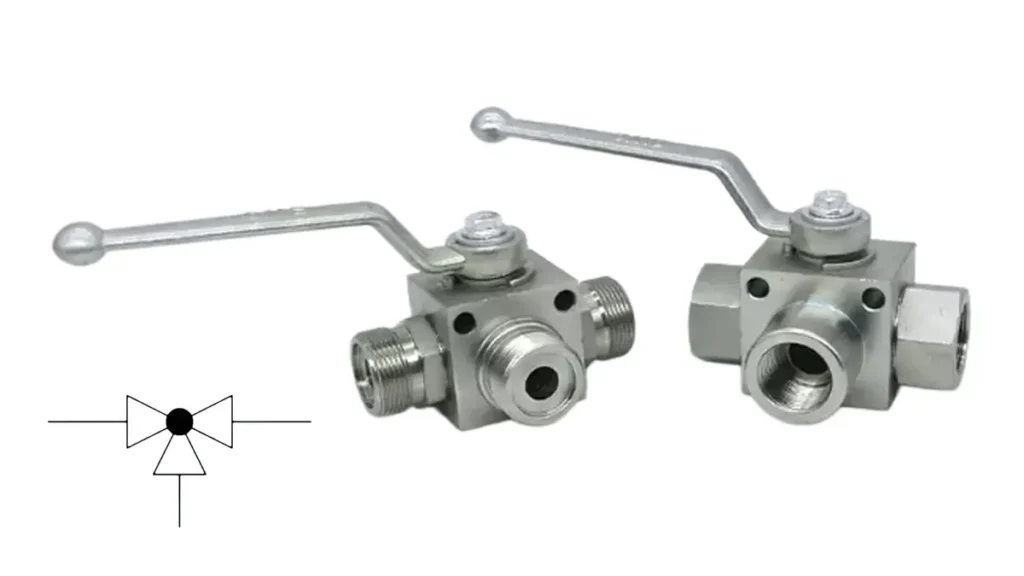
When you see a 3 way ball valve hydraulic symbol, you can tell how oil moves between three ports. The symbol shows three triangles pointing at each other. There is a ball in the middle. Sometimes, you see a boxed “H” on top. This means it is for hydraulic use. The symbol helps you understand how oil flows in a drawing. It does not show every detail about the real valve. You must check things like pressure rating and port size. You also need to look at connection type, material, seat, seal, and working conditions before picking a valve. Look at this table for common schematic standards:
| Valve Type | Symbol Characteristics | Designation |
|---|---|---|
| 3-way Ball Valve | Like 2-way valves but with one more triangle | L-port or T-port |
You see this symbol in hydraulic diagrams for machines and test benches. It is also used in many kinds of industrial equipment.
Key Takeaways
- The 3-way ball valve hydraulic symbol shows how oil moves between three ports. This helps you see the flow paths in hydraulic systems.
- Find the boxed ‘H’ in the symbol to make sure it is for hydraulic use. This helps you use it the right way.
- The symbol has three triangles and a circle in the middle. These show the valve’s ports and the ball that controls the flow.
- You can spot L-port and T-port types by looking for their shapes inside the symbol. These shapes show different ways the oil can move.
- Always check the ball valve symbol in diagrams before you install it. This helps you avoid mistakes and connect things the right way.
- The ball valve symbol makes reading hydraulic schematics easier. It helps you plan and fix systems faster.
- After you check the symbol, look at technical details like pressure ratings and material compatibility. This makes sure the valve works for your needs.
- People sometimes mix up L-port and T-port symbols. This can cause wrong flow paths and make the system fail.
What Is the 3 Way Ball Valve Hydraulic Symbol?
Symbol Elements
You might wonder what makes up the 3 way ball valve hydraulic symbol. When you look at piping and instrumentation diagrams, you see a special mark that stands out. The ball valve symbol shows you the main parts of the valve in a simple way. Here’s what you usually spot:
- The symbol starts with a valve-body outline. This shape tells you where the valve sits in the system.
- In the center, you see a circle or a bore line. This shows the closure element, which is the ball inside the valve.
- For a three-way hydraulic ball valve, the symbol adds a third connection. This branch comes off the main line and lets you know there are three ports.
- Sometimes, you notice an L or T shape inside the center mark. These shapes show the ball passage. An L-port connects two ports next to each other. A T-port connects different pairs of ports.
You can spot these features in piping and instrumentation diagrams. The ball valve symbol helps you figure out how the valve works without seeing the real thing. If you see a boxed “H” above the symbol, that means the valve is for hydraulic use.
Schematic Representation
When you read piping and instrumentation diagrams, you need to know what each symbol means. The ball valve symbol gives you a quick way to identify the valve’s function and location. You don’t have to guess where the oil goes. The symbol shows you the flow paths between the three ports.
In a typical diagram, you see three triangles pointing toward each other. The ball sits in the middle. The boxed “H” tells you it’s a hydraulic valve. The ball valve symbol doesn’t show every detail, but it gives you a clear idea of how oil moves. You can tell if the valve switches, diverts, or connects flow.
You use the ball valve symbol in piping and instrumentation diagrams for machines, test benches, and industrial equipment. It’s a standardized graphical representation that makes reading schematics easier. You can quickly spot a 3-way hydraulic ball valve and understand its role in the system.
If you want to see how the ball valve symbol works, look for the arrows and lines. These marks show you the direction of flow. You can see which ports connect and which ones stay closed. The ball valve symbol helps you avoid mistakes when you build or fix hydraulic systems.
Tip: Always check the ball valve symbol in piping and instrumentation diagrams before you select or install a valve. The symbol shows you the function, but you still need to check the specs for your application.
Why the Ball Valve Symbol Matters
Function vs. Product Details
You see the ball valve symbol in most hydraulic diagrams. It shows how oil moves and which ports connect. The symbol does not show everything about the valve. It only shows what the valve does. The ball valve symbol helps you understand basic actions like switching or combining flows. It does not show things like pressure rating or material.
If you only use the ball valve symbol, you might miss important facts. You need to check the real product specs before picking a valve. The symbol gives you a quick idea about flow control, but you must look for details like seat type and seal material. The ball valve symbol is a shortcut for understanding the circuit. It does not replace technical data.
Note: The ball valve symbol shows how the valve works in the system. It does not show how the valve is built or what it can handle.
Importance in Hydraulic Design
When you design a hydraulic system, you use the ball valve symbol to plan oil flow. The symbol helps you map out flow control and decide where to put valves. You can see which ports connect and how the valve changes the flow path. This makes building circuits easier.
The ball valve symbol helps you avoid mistakes. If you misread the symbol, you can make errors in the system. Here are some common misunderstandings when you misinterpret the ball valve symbol:
- Mixing up relief and reducing valve symbols can lead to wrong ideas about circuit protection.
- Ignoring the neutral condition makes you misunderstand how the system acts when idle.
- Missing pilot circuit restrictions can cause you to misdiagnose main valve failures.
- Thinking diagram layout shows real locations can result in service errors.
- Forgetting drain line importance can cause problems and failures.
- Misreading load-holding circuits can cause performance issues, especially if you confuse pilot-operated checks with counterbalance valves.
- Ignoring component enclosure boundaries can lead to unnecessary disassembly and damage.
You need to read the ball valve symbol carefully. It shows the function, but the diagram does not show everything. You should always check specs and understand flow paths before you install or fix a valve.
The ball valve symbol is important in hydraulic design. It lets you plan, troubleshoot, and improve your system. You can spot flow paths, see which ports connect, and make smart choices about valve placement. If you use the ball valve symbol the right way, you build safer and more reliable hydraulic circuits.
Three-Way Hydraulic Ball Valve Structure
Ports and Flow Paths
When you look at a three-way hydraulic ball valve, you see three ports. Each port connects to a different part of your hydraulic system. The ball valve symbol shows these ports as branches coming off the main line. You use the ball valve symbol to figure out which ports connect when you turn the handle.
Inside the valve, you find several important parts. These parts work together to control the flow of oil. Here’s a table that breaks down the main components and their functions:
| Component | Function |
|---|---|
| Valve Body | Holds everything together and keeps oil from leaking. Usually made from strong materials. |
| Ball | Has a hole that lines up with the ports. Lets you switch the flow path. |
| Stem | Connects the ball to the handle. Needs to be tough and leak-proof. |
| Handle/Actuator | Lets you turn the valve. Can be manual or automatic. |
| Seats/Seals | Press against the ball and body to stop leaks. Often made from PTFE for a tight seal. |
| Three-Port Structure | Gives you more options for mixing, diverting, or isolating flow than a two-way valve. |
The ball valve symbol helps you see how these parts work together. You can spot the ball in the center of the symbol. The three branches show the ports. When you turn the handle, the ball rotates and changes which ports connect. This is one of the main flow control mechanisms in hydraulic systems.
You might wonder how the port arrangement affects the valve’s function. The ball valve symbol makes it easy to see the difference between L-port and T-port types. Here’s a quick table to help you understand:
| Valve Type | Functionality Description |
|---|---|
| L-port | Changes flow direction by closing one port and opening another when you turn the handle 90 degrees. |
| T-port | Lets you mix oil from two ports. You can have all three ports open at the same time. |
The ball valve symbol shows you which type you have. If you see an L shape inside the symbol, you know it’s an L-port. If you see a T shape, it’s a T-port. This helps you pick the right valve for your flow control mechanisms.
Normal Position Connections
You need to know how the ports connect when the valve is in its normal position. The ball valve symbol gives you a clear picture. In most hydraulic diagrams, the normal position shows which ports are open and which are closed.
If you have an L-port valve, the ball valve symbol shows two ports connected. The third port stays closed. When you turn the handle, the ball rotates and connects a different pair of ports. You use this setup to switch flow between two lines.
For a T-port valve, the ball valve symbol shows all three ports connected. You can mix oil from two sources or send oil to two places at once. This setup gives you more flexibility in your hydraulic circuit.
You can use the ball valve symbol to check the normal position before you install or operate the valve. Look for arrows or lines in the symbol. These marks show you the flow direction. If you see all three ports connected, you know it’s a T-port. If only two ports connect, it’s an L-port.
Tip: Always check the ball valve symbol in your diagram before you start work. It helps you avoid mistakes and keeps your hydraulic system running smoothly.
The ball valve symbol makes it easy to understand how the valve works. You can see the ports, the ball, and the flow paths. This helps you plan your system and choose the right flow control mechanisms for your needs.
3 Way Ball Valve Hydraulic Symbol Diagram
Standard Diagram
You might wonder what the 3 way ball valve hydraulic symbol looks like in a real diagram. Let’s break it down together. The ball valve symbol uses simple shapes to show you how the valve works. You will see three triangles, each one pointing toward the center. In the middle, there is a circle. This circle stands for the ball inside the valve. Sometimes, you see a boxed “H” above the symbol. That means the valve is for hydraulic systems.
Here’s a basic diagram you might find in a hydraulic schematic:
      [H]
       |
   ▲   |   ▲
    \  |  /
     \ | /
      (O)
     / | \
    /  |  \
   ▲   |   ▲
- The triangles show the three ports.
- The circle in the center is the ball.
- The boxed “H” means hydraulic use.
You can use this ball valve symbol to quickly spot a three-way valve in any drawing. The symbol does not show every detail, but it gives you a clear idea of how oil can move through the valve.
Key Parts Labeled
Let’s look at the key parts of the ball valve symbol and see how you can read it step by step. A labeled diagram helps you understand how the valve operates and which ports connect in each position. It also shows you the flow direction, so you can avoid mistakes when you install or service the valve.
Here’s a simple table to help you match each part of the ball valve symbol to its real function:
| Symbol Part | What It Means |
|---|---|
| Triangle | Port (connection point) |
| Center Circle | Ball (flow control element) |
| Boxed “H” | Hydraulic application |
| Lines/Arrows | Flow direction and open paths |
| L or T inside | Type of ball passage (L-port or T-port) |
When you read the ball valve symbol, follow these steps:
- Find the triangles. Each one is a port. Count them to make sure you have a three-way valve.
- Look for the circle in the center. This is the ball. It tells you the valve can switch or mix flow.
- Check for a boxed “H” on top. This means the valve is for hydraulic oil, not air or water.
- Notice any lines or arrows. These show you which ports connect when the valve is in a certain position.
- If you see an L or T shape inside the circle, you know what kind of flow path the ball creates.
A labeled diagram makes everything clear. You can see if the valve will mix, divert, or select oil flow. You can also tell which port is the common port. This helps you plan your piping and avoid wrong connections.
Here’s why a labeled ball valve symbol is so helpful:
- You see exactly how the valve operates.
- You know which ports connect in each position.
- You understand the overall flow direction.
- You can prevent installation mistakes.
- You can tell if the valve will mix, divert, or select flow.
If you ever feel confused by a hydraulic drawing, just go back to the ball valve symbol. It gives you a quick way to check flow paths and port connections. You will feel more confident when you build, repair, or design a hydraulic system.
Tip: Always double-check the ball valve symbol before you start work. A quick look can save you a lot of trouble later.
L-Port and T-Port Ball Valve Symbol
L-Port Symbol and Flow
You see the ball valve symbol in many hydraulic diagrams. When you spot an L shape inside the symbol, you know you are looking at l-port hydraulic ball valves. The L-port ball valve symbol shows you how the valve diverts oil flow between three ports. You can use this valve to switch oil from a common inlet to one of two outlets. The ball valve symbol makes it easy to see which ports connect when you turn the handle.
Let’s break down how the L-port works. The ball valve symbol uses three triangles and a central circle. The L shape inside the circle tells you the flow path. When you rotate the handle, the ball inside the valve turns. This action connects the common port to either outlet. You can control which tank or line receives oil. The ball valve symbol helps you avoid mistakes by showing the exact flow direction.
Here’s a quick look at the flow path:
- The ball valve symbol shows two ports connected at a time.
- The third port stays closed.
- You can switch flow between two tanks or lines.
You might use L-port ball valves to regulate flow to two tanks. The ball valve symbol gives you a clear picture of this function. If you see arrows in the symbol, you know which way the oil moves. You can trust the ball valve symbol to guide you during installation and troubleshooting.
T-Port Symbol and Flow
Now, let’s talk about the T-port ball valve symbol. You spot a T shape inside the central circle. The ball valve symbol for T-port valves shows you a different flow path. You can mix oil from two inlets into one outlet. The ball valve symbol helps you see all three ports connected at the same time.
The T-port ball valve symbol uses three triangles and a circle, just like the L-port. The T shape inside the circle tells you the ball passage. When you turn the handle, the ball rotates and opens all three ports. The ball valve symbol shows you how oil can flow from two sources and combine in one line.
Here’s what happens with the T-port:
- The ball valve symbol shows all three ports open.
- You can mix fluids or send oil to two places at once.
- The symbol helps you plan for mixing or distributing oil.
You might use T-port valves to mix hot and cold water. The ball valve symbol makes this easy to understand. If you see lines or arrows in the symbol, you know the flow direction. The ball valve symbol helps you avoid confusion and ensures you connect the right lines.
Let’s compare L-port and T-port ball valve symbol functions in a table:
| Valve Type | Flow Path Description | Application Example |
|---|---|---|
| L-port | Diverts fluid flow from a common inlet to one of two outlets | Regulating flow to two tanks |
| T-port | Mixes fluids from two inlets into one outlet | Mixing hot and cold water |
Tip: Always check the ball valve symbol in your diagram. You can spot the L or T shape and know exactly how the valve will control oil flow. This saves you time and prevents mistakes.
The ball valve symbol gives you a fast way to understand flow paths. You can see if the valve will divert, mix, or distribute oil. When you use the ball valve symbol, you make smarter choices for your hydraulic system.
Reading Flow Direction in the Symbol
Arrows and Lines
When you look at a ball valve symbol, you might see arrows or lines. These marks help you understand how oil moves through the valve. The arrows show you the direction of flow. The lines connect the ports that are open. You can use these clues to figure out what happens inside the valve.
Let’s break it down:
- Arrows point from one port to another. This tells you where the oil goes.
- Solid lines mean the path is open. Oil can move along these lines.
- Sometimes, you see dashed lines. These lines show a possible path, but it is not open in the current position.
You can find these arrows and lines in almost every ball valve symbol. If you see an arrow from the left port to the bottom port, you know oil flows that way. If there is no arrow, that path stays closed. The ball valve symbol makes it easy to see what is happening without opening the valve.
Tip: Always follow the arrows in the ball valve symbol. They show you the real flow direction. If you miss an arrow, you might connect the wrong line.
Here is a simple example:
| Symbol Part | What It Shows |
|---|---|
| Arrow | Flow direction |
| Solid Line | Open path |
| No Line | Closed path |
You can use this table when you read any ball valve symbol. It helps you check your work and avoid mistakes.
Open and Closed Paths
The ball valve symbol also shows you which paths are open and which are closed. You do not need to guess. The symbol gives you a clear picture. When you see two ports connected by a line, that path is open. If a port has no line, it is closed.
Let’s look at how this works:
- Find the lines in the ball valve symbol.
- Check which ports connect with a solid line.
- If you see a line, oil can flow between those ports.
- If there is no line, that port stays closed.
You can use this method for both L-port and T-port valves. The ball valve symbol always shows you the open and closed paths. For an L-port, you see two ports connected and one closed. For a T-port, you might see all three ports open.
Here is a quick checklist for reading open and closed paths in a ball valve symbol:
- Look for solid lines between ports.
- Check for arrows to see flow direction.
- Notice if any port has no line. That port is closed.
- Use the symbol to plan your connections.
Note: The ball valve symbol helps you avoid wrong connections. You can see the open and closed paths before you start your work.
If you practice reading the ball valve symbol, you will get faster and make fewer mistakes. The symbol is your guide. It shows you everything you need to know about flow direction and port connections.
Selecting a Three-Way Hydraulic Ball Valve
Matching Symbol to Function
Choosing the right valve starts with reading the ball valve symbol. You want to make sure the symbol matches the job you need the valve to do. If you skip this step, you might end up with the wrong flow path or connections. Here’s how you can match the ball valve symbol to your function:
- Check the port arrangement. The ball valve symbol shows you where each port sits. Count the branches to confirm you have three.
- Look for the type of flow path. The ball valve symbol will have an L or T inside the center. An L-port lets you switch between two lines. A T-port can mix or split flow.
- Confirm the valve’s positions. The ball valve symbol in your project legend or diagram tells you how the valve operates in each position. Make sure it matches your system’s needs.
Tip: Always double-check the ball valve symbol before you order or install a valve. This step saves you time and prevents costly mistakes.
If you see a ball valve symbol with three triangles and a circle, you know you’re dealing with a 3-way hydraulic ball valve. The symbol gives you a quick way to spot the right valve for switching, mixing, or diverting oil flow.
Key Selection Criteria
After you match the ball valve symbol to your function, you need to look at the technical details. Not all valves are the same. You want a three-way hydraulic ball valve that fits your system and lasts a long time. Here’s a table to help you compare the most important specs:
| Specification | Description |
|---|---|
| Valve Configuration | L-port or T-port designs change flow direction and fit different jobs. |
| Material Compatibility | PTFE works for most oil. For high heat or tough fluids, pick PEEK or metal seats. |
| Actuation Method | Manual levers work for simple jobs. Use pneumatic or electric if you want automation. |
| Port Size and Connection Type | Threaded ends fit small pipes. Flanged or welded ends work for big or high-pressure systems. |
| Pressure and Temperature Ratings | Make sure the valve can handle your system’s highest pressure and temperature. |
You can use this table as a checklist. Start with the ball valve symbol to pick the right flow path. Then, check each technical detail. If you need to handle hot oil or high pressure, pick a valve with the right material and rating.
Note: The ball valve symbol helps you see the function, but you must check the specs for safety and performance.
If you follow these steps, you’ll find a three-way hydraulic ball valve that matches your diagram and works well in your system. You’ll avoid leaks, breakdowns, and downtime. The ball valve symbol is your guide, but the specs make sure you get the right valve for the job.
Common Mistakes with Ball Valve Symbols
When you read a hydraulic diagram, you want to get things right. The ball valve symbol helps you understand how oil moves, but it’s easy to make mistakes if you’re not careful. Let’s look at the most common problems you might face with the ball valve symbol.
L-Port vs. T-Port Confusion
You might see an L shape or a T shape inside the ball valve symbol. These shapes look simple, but they mean very different things. If you mix them up, your system might not work as you expect.
Here’s what usually happens:
- You see a ball valve symbol with an L shape. You think it connects all three ports, but it only connects two at a time.
- You spot a T shape in the ball valve symbol. You believe it works like an L-port, but it can connect all three ports together.
- You order the wrong valve because you didn’t check the ball valve symbol closely.
Let’s make it clearer with a table:
| Symbol Shape | What It Means | Common Mistake |
|---|---|---|
| L shape | Connects two ports | Thinking all three connect |
| T shape | Can connect all ports | Using it to switch only two |
Tip: Always look for the L or T inside the ball valve symbol. Double-check before you buy or install a valve.
If you mix up the L-port and T-port, you might send oil to the wrong place. The ball valve symbol gives you the answer if you pay attention.
Flow Path Errors
Another big mistake comes from not following the flow paths in the ball valve symbol. You might think a port is open when it’s actually closed. This can cause leaks, pressure problems, or even damage.
Here’s how these errors happen:
- You skip the arrows or lines in the ball valve symbol. You guess which ports connect.
- You forget to check the ball valve symbol when you change the valve position.
- You connect hoses based on memory, not the ball valve symbol.
Let’s use a checklist to help you avoid these mistakes:
- Always follow the arrows in the ball valve symbol.
- Check which ports connect in each position.
- Never guess—use the ball valve symbol as your guide.
Note: The ball valve symbol shows you open and closed paths. If you ignore it, you risk making costly errors.
You can avoid most problems by slowing down and reading the ball valve symbol every time. The symbol is there to help you. Use it, and you’ll keep your hydraulic system safe and reliable.
Applications in Hydraulic Systems
Power Units and Test Benches
You see the ball valve symbol in almost every hydraulic power unit diagram. These units need to control oil flow between pumps, tanks, and actuators. When you spot the ball valve symbol, you know you can switch, mix, or divert oil with just one valve. This makes your job easier and keeps your system flexible.
Test benches use the ball valve symbol for quick changes in flow direction. You might need to test different cylinders or motors. The ball valve symbol shows you which ports connect, so you can set up your test fast. If you want to isolate a part of the system, just look for the ball valve symbol. You can close off one line and keep the rest running.
Here’s a quick list of how you use the ball valve symbol in power units and test benches:
- Switch oil flow between two circuits.
- Mix oil from two sources.
- Isolate a pump or actuator for safety.
- Divert flow to a test port.
Tip: Always check the ball valve symbol before you change connections. This helps you avoid mistakes and keeps your equipment safe.
Industrial Machinery
You find the ball valve symbol in many types of industrial machines. It helps you control oil flow in presses, injection molding machines, and even food processing lines. When you read a machine’s schematic, the ball valve symbol tells you how the oil moves. You can see if the valve will mix, divert, or select flow.
In a factory, you might need to switch between different tools or workstations. The ball valve symbol shows you which lines connect. If you need to stop oil to one part of the machine, just follow the ball valve symbol. You can close a port and keep the rest of the system working.
Let’s look at a table of common uses for the ball valve symbol in industrial machinery:
| Application | How the Ball Valve Symbol Helps |
|---|---|
| Presses | Diverts oil to different cylinders |
| Injection molding machines | Mixes oil for temperature control |
| Food processing lines | Switches flow between cleaning cycles |
| Conveyor systems | Isolates sections for maintenance |
You can trust the ball valve symbol to guide you when you build, repair, or upgrade machines. If you ever feel unsure, just go back to the ball valve symbol in the diagram. It gives you a clear picture of what will happen when you turn the valve.
Note: The ball valve symbol is your best friend in the plant. It helps you work faster and safer every day.
Conclusion
You now know why the 3-way hydraulic ball valve symbol matters. It helps you read schematics and pick the right valve for switching, diverting, or combining oil flow. Remember, the symbol shows how a valve works but not every detail. Always check pressure, size, and material before you choose a three-way hydraulic ball valve. We are a Hydraulic Ball Valve manufacturer at Chenyang Hydraulic. We make high pressure and custom valves, too. If you need help, reach out for expert support.
FAQ
What does the 3-way ball valve hydraulic symbol show?
You see how oil flows between three ports. The symbol uses triangles, a circle, and sometimes a boxed “H” to show connections and flow paths in a hydraulic system.
How can I tell if the valve is L-port or T-port?
Look inside the symbol. An “L” shape means L-port. A “T” shape means T-port. This tells you how the valve connects the ports and controls oil flow.
Why do I need to check the symbol before buying a valve?
The symbol shows the function, not the specs. You need to match the symbol to your system’s needs. Always check pressure, size, and material before you buy.
Can I use the same valve for water and oil?
No, you should not. Hydraulic ball valves are made for oil. If you use them for water, you might get leaks or damage. Always check the application.
What happens if I mix up the flow paths?
You could send oil to the wrong place. This might cause leaks, pressure loss, or even damage your equipment. Always follow the symbol and arrows in your diagram.
Where can I get help choosing the right hydraulic ball valve?
You can ask us! We are a hydraulic ball valve manufacturer. We help you pick the right valve for your system. Just contact our team for support.